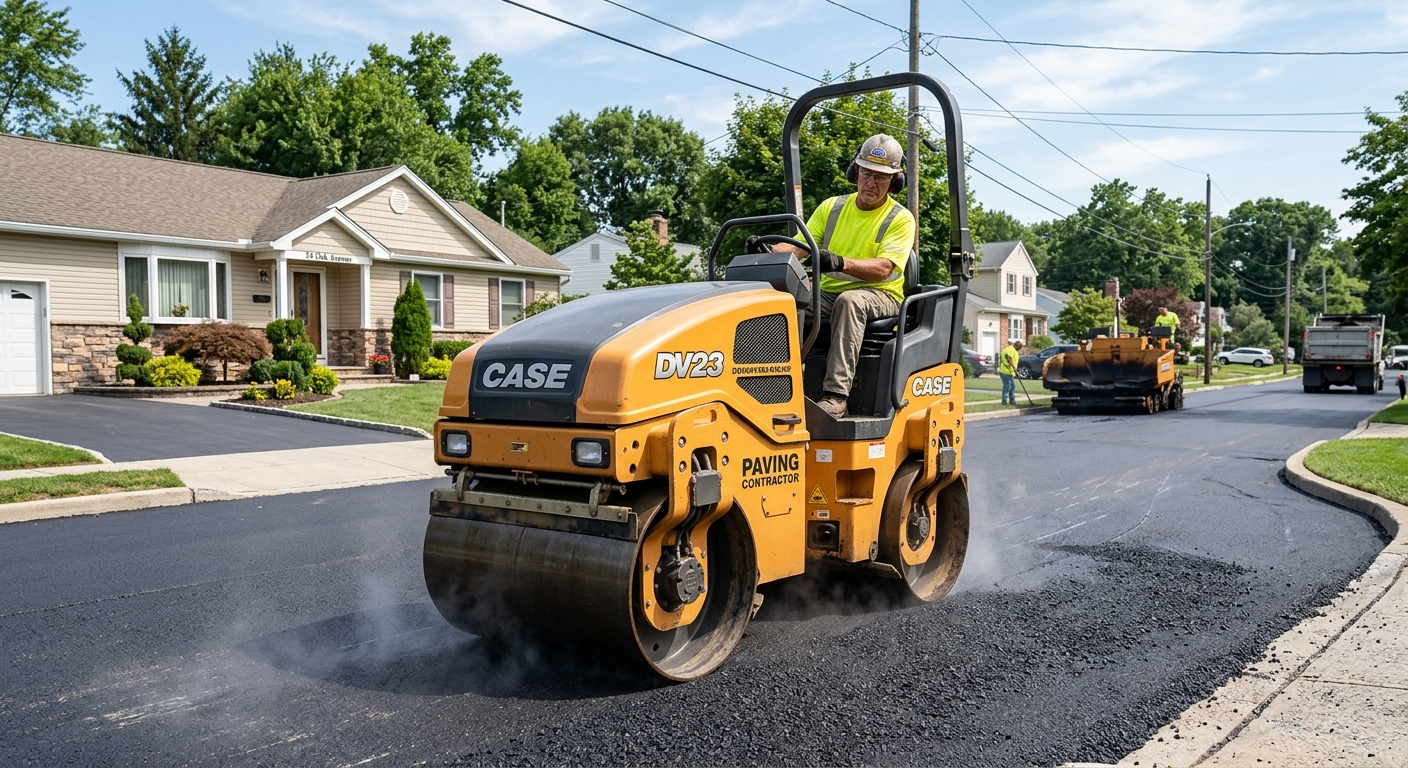
Driveway paving costs in West Brandywine — 2026
In West Brandywine, where 92.4% of homes are owner-occupied and 76.0% are single-family houses (U.S. Census Bureau, ACS 2024), your driveway isn't just decoration—it's a necessity, and replacement is squarely your responsibility. Paving costs here reflect more than material or square footage. The region’s moderate freeze-thaw cycle, combined with limestone and dolomite bedrock, means what happens under your driveway determines how long it will last. The harsh reality: the biggest difference between two quotes is usually buried deep—underground, in the base and prep you will never see after day one.
A full asphalt replacement in West Brandywine ranges from $3,900–$10,000, but a lower quote often means corners cut where it does the most harm—in excavation, base thickness, or drainage. Overlay jobs, where new asphalt is placed over a sound base, run $1,650–$5,000. If the base is shot, overlays rarely last. Preventive maintenance such as sealcoating, at $225–$800 per application, extends life if the pavement is already in good shape, but it cannot fix existing structural issues.
Concrete is more expensive, at $5,600–$13,500 for installation, but offers longer service life with far less maintenance. Isolated crack filling or patching typically costs $200–$800, and rural gravel driveways, common on longer runs, run from $900–$3,500. To put it simply: no two quotes reflect the same grade of unseen labor or material, and that’s where the difference will matter three winters from now.
| Service |
Best for |
Lifespan |
Price range |
| Asphalt — full replacement with new base |
failed base, structural cracking |
20–30 yrs |
$3,900–$10,000 |
| Asphalt overlay / resurfacing |
sound base, surface cracking only |
8–15 yrs |
$1,650–$5,000 |
| Sealcoating — single application |
preventive maintenance on sound asphalt |
2–4 yrs |
$225–$800 |
| Concrete — new installation |
long service life, low maintenance |
30–50 yrs |
$5,600–$13,500 |
| Crack filling and patching |
isolated cracks under a quarter inch |
1–3 yrs |
$200–$800 |
| Gravel driveway |
rural, budget, long runs |
5–10 yrs with upkeep |
$900–$3,500 |
Estimates for a typical West Brandywine driveway. Square footage and base condition drive these figures more than material choice.
What's under the asphalt matters more than the asphalt
What you see on top—the fresh, black asphalt—is only the surface. What matters for your West Brandywine driveway is what’s below: the subgrade, the compacted stone base, and then the asphalt riding course. Each layer distributes the weight of vehicles to the one beneath. If even one of these steps is skipped, or not done to standard, it will fail—and often not right away, but in year three or four, when you’re on your own.
Central Chester County's limestone and dolomite soils drain better than clay but still make for unpredictable underlayment. In our moderate freeze-thaw region, water in the subgrade expands as it freezes, lifting and cracking the pavement from below—this is frost heave. Many failures trace back to a thin or soft stone base, lack of compaction, or improper drainage that leaves water to linger under the slab. That’s why base thickness and drainage matter here more than in milder climates, and why they cost more up front.
If you see a price much lower than the average, there’s only one way that’s possible: the crew is rushing, skipping on excavation, not using the right aggregate, or compacting too little. None of this shows on the first day. But by the third winter, you’ll see cracks, heaving, or sunken spots. Once the base fails, resurfacing is a Band-Aid at best.
DIG IN: Demand—on paper, not a handshake—at least 6–8 inches of compacted crushed stone base (2A or similar), placed and compacted in multiple lifts, not all at once. Specify the type of aggregate and insist on written proof that mechanical compaction was performed at each stage. Your future self will thank you.
Numbers, not adjectives
If you’re comparing driveway quotes in West Brandywine, look past “best materials” or “heavy duty.” Adjectives mean nothing and won’t make your pavement last. Specs do. The right question is: what depth, what stone, what compaction method—and was every layer done in lifts, with thickness stated compacted, not just when dumped?
The difference here in Chester County, where subgrade can mean limestone, and the winters bring freeze-thaw cycles, is that proper driveways have deeper bases than you’ll see in milder regions. An inch short on stone, or skimped compaction, means big trouble fast. Don’t let a contractor get away with “about three inches” of asphalt. Three inches leveled out is not three inches compacted. After the roller, you should get what is on your contract, not just what went down off the truck.
- Excavation depth (state inches removed, not just “graded”)
- Depth of compacted aggregate base (minimum 6–8 inches for this region)
- Type of aggregate base (e.g., 2A modified stone)
- Base compaction in lifts (no lift thicker than 4 inches uncompacted)
- Proof of mechanical compaction at every lift
- Asphalt binder course depth (compacted, typically 2–2.5 inches)
- Asphalt surface course depth (compacted, typically 1.5–2 inches)
- Asphalt mix grade/type (e.g., PennDOT ID-2 or ID-3)
- Edge restraint details (tamped edges or concrete restraint, not loose ends)
- Drainage grading to direct water off pavement (minimum 2% cross-slope)
What you need before paving in West Brandywine
If you’re repaving an existing driveway within your current footprint, most Chester County townships (including West Brandywine) often do not require a driveway permit; the local offices focus their attention elsewhere. That said, if you plan to expand, resurface within the public right-of-way, or replace a driveway approach where your drive meets the road, a permit is usually required—and not from who you might expect. In Chester County, a new or modified driveway approach connecting to a state road always requires a Highway Occupancy permit from PennDOT Engineering District 6-0, not just your township office.
Adding or expanding any hard surface can also trigger stormwater rules. Municipalities may review runoff impact, and you can be liable for water sent onto a neighbor’s property whether or not your permit is in order. So be honest about your plans with your township and double-check if your street is state or township owned.
To protect yourself, Pennsylvania law requires that every contract over $500 for paving work must be in writing, per the Home Improvement Consumer Protection Act (HICPA). The contractor must also show a valid Home Improvement Contractor registration—verify it at hic.attorneygeneral.gov. If they have employees, workers’ compensation is mandatory; you can verify this through WCAIS (wcais.pa.gov) before you sign anything.
Drainage: the failure nobody plans for
It’s not the ice or the sun that wrecks most West Brandywine driveways—it’s water. Water that sits, seeps, or runs along the wrong path accounts for the majority of failures, from cracked edges to sunken pavement. That’s why, in this area’s moderate freeze-thaw climate, surface grading and drainage design should be your first questions, not an afterthought.
Every paved driveway should be laid to a minimum 2% slope to shed water. For flat lots, crowning the middle so water drains to both sides works, but on narrow drives, a single cross-slope away from the house is safest. If your driveway naturally slopes towards your garage or foundation, plan for a trench or channel drain at the low point; don’t just accept standing water at the threshold.
Chester County’s limestone and dolomite soils drain better than clay—but that just means quicker infiltration. Water still trapped in the subgrade freezes, expands, and lifts the base in winter, which compounds damage each year. Your options: daylight drains to a safe outflow or, with no downhill, a properly sized dry well—not a pit that fills up by February.
And one warning you can’t ignore: diverting runoff onto a neighbor’s property, intentionally or otherwise, creates legal liability no matter what your permit says. Good drainage is a bargain compared to a lawsuit or a ruined driveway.
Local soil, drainage and driveway lifespan
In central Chester County, including West Brandywine, most residential sites rest on limestone and dolomite bedrock. These soils have better drainage than heavy clay but can settle unpredictably, especially with older driveways where the base was never built thick enough to begin with. This is why Chester County driveways often need a thicker aggregate base—just going by what works one county north or west will cost you here in settlement and cracking.
The area faces regular freeze-thaw cycles, with a typical frost depth of 30 inches. Water soaking into limestone subgrade can migrate and collect, causing subtle voids or sudden settling if an old base gets compromised. For driveways from the 1960s–1980s—common as neighborhoods like Exton and West Goshen developed—many were paved over marginal bases when construction standards were less stringent. If this is your house, assume you need a full-depth rebuild, not just a cosmetic overlay.
What does this mean in practice? Plan for more excavation, at least 6–8 inches of compacted stone, and a drainage plan tailored to prevent water from traveling under your new pavement. Shortcuts here are false economy: settling or frost heave can turn a new drive into a patchwork in just a few years.
Widening, extending or adding a parking pad
Driveway projects that go beyond a straight replacement—like widening for extra vehicles, extending out to a detached garage, or finally paving that gravel parking pad—come with a different set of requirements and long-term risks. When you expand the footprint, every new section sits on undisturbed soil, so you’ll need full-depth excavation and a fresh aggregate base matched to the existing grade. But here’s the catch: the seam between old and new is forever a weak spot, particularly where freeze-thaw and different settlement rates play out each season. Seam failures are common in West Brandywine’s climate unless the prep work is top-notch.
New work also brings fresh rules. Adding impervious surface can trigger stormwater management requirements, and township or PennDOT approval is required when you change the entry point, especially if it’s along a state route—this means a Highway Occupancy permit. Don’t guess where your property lines are, either; setbacks may prevent you from paving right up to the edge. Even if no building permit is needed for the work inside your lot, approach permits and runoff rules still apply, so check all bases before you start.
Frequently asked questions — driveway paving in West Brandywine
Do I need an approach permit where my driveway meets the road?
In West Brandywine and Chester County, any time you’re modifying or installing a driveway that connects to a state road (not just repaving inside your property), you need a Highway Occupancy permit. This is handled by PennDOT Engineering District 6-0—not your township road office. The process checks sight lines, runoff, and potential impact on public right-of-way. You don’t need this for routine maintenance inside your own boundary, but if you’re changing the entry point or adding a new apron, the permit is mandatory. Not having the right permit can lead to fines, forced removal, or legal snags if you ever sell. For peace of mind and legal compliance, budget it in with your paving work, especially for full replacements (think $3,900–$10,000 jobs) or expansions.
How long before I can drive on a new asphalt driveway?
After your new asphalt goes down in West Brandywine, plan to wait at least 2–3 days before driving a standard vehicle on it, and a full week for heavier vehicles like delivery trucks or RVs. Our summers tend to be humid and warm, which helps with curing but also means soft asphalt if you rush. Parking too soon can create permanent depressions that are impossible to fix without resurfacing. Cooler fall or spring weather may extend curing time by another day or two. If you’re investing in a full-depth pave (in the $3,900–$10,000 range), patience up front protects your investment and gives you a lasting, even surface.
Is an overlay worth it or should I start over?
An asphalt overlay, which runs $1,650–$5,000 in West Brandywine, can give a tired driveway with surface cracks a “like new” look at a modest cost. But overlays rely on the strength and evenness of the existing base. If your old drive has potholes, sunken or heaved spots, or deep cracks, overlaying just hides the problem for a few years at best; these failures will reflect right through. West Brandywine’s combination of limestone soils and freeze-thaw cycles quickly exposes weak bases. If you’re seeing wide cracks, standing water, or significant sinking, put your money toward a full-depth replacement. For minor wear and good structure, an overlay stretches useful life while delaying a bigger expense.
Does sealcoating fix cracks?
Sealcoating in West Brandywine, typically $225–$800 per application, is maintenance—not repair. It seals out water, protects against sun and oil stains, and keeps the surface black, but it won’t fill or structurally repair cracks. Fine “hairline” cracks may be minimized visually, but anything deeper than surface stress needs crack filling first. Ignoring bigger cracks invites water infiltration, which is a recipe for frost heave and base damage in our freeze-thaw climate. Sealcoating gives your driveway the best life when applied to a solid, intact surface. If damage is significant, address that before considering a sealcoat.
What does compaction in lifts mean?
“Compaction in lifts” is a must in Pennsylvania’s variable soils. Instead of dumping all the stone or asphalt at once, the base or blacktop is spread in thin layers—usually 3–4 inches at a time—and then compacted with heavy equipment before the next layer goes down. This method prevents weak spots, honeycombing, and uneven settling, which are problems in Chester County’s limestone subgrade. Skipping this step is how cheap contractors cost you thousands down the road. You want this specified in your contract, especially on full replacements in the $3,900–$10,000 range, to guarantee even strength through the entire base and surface layers.
What does an asphalt overlay cost in West Brandywine?
For an asphalt overlay or resurfacing in West Brandywine, the typical cost is $1,650–$5,000. This price assumes your existing base is solid—just surface cracks, no deep potholes or soft spots. The advantage is getting a fresh, smooth driving surface for half to two-thirds the price of a full-depth replacement. However, know that overlays last only about 8–15 years in our area’s climate, so they’re best suited for driveways with a strong foundation. Anything less, and you risk paying twice. Always get an assessment before deciding; sometimes, patching or remedial base work is needed to make an overlay a good investment.
Is gravel a cheaper option in West Brandywine?
Gravel is the lowest upfront cost for driveway surfacing in West Brandywine, typically between $900–$3,500 for a standard run. It’s a smart option for long rural drives or budget-conscious owners who don’t mind occasional ruts and annual regrading. However, in densely developed subdivisions or for short suburban driveways, the ongoing upkeep and mess (dusty in summer, muddy in spring) can become more hassle than it’s worth. If your HOA or local codes allow it, gravel is an option—but don’t count on resale value or curb appeal matching that of asphalt or concrete. For most homeowners in this market, gravel works best as a secondary pad or seldom-used parking lane.
Does West Brandywine have local asphalt plants?
Yes, the proximity of multiple quarries and asphalt plants near Downingtown and Coatesville, both just a short haul from West Brandywine, helps keep paving costs stable and job schedules tight. Supply logistics are rarely a problem here, so you can expect your driveway to be paved with fresh, hot-mix asphalt rather than recycled leftover stock. This not only supports better finish quality, but also keeps your costs more predictable—no premium for special delivery built in. For full replacements—typically in the $3,900–$10,000 range—this regional advantage keeps projects on time, even during the peak season.
How long should an asphalt driveway last in West Brandywine?
With a properly prepared base and good drainage, an asphalt driveway in West Brandywine should last 20–30 years. Failures before then usually trace back to shortcuts on excavation or a too-thin stone bed—which are hidden costs in suspiciously cheap quotes. Our moderate freeze-thaw cycles and limestone soils mean moisture moves in and out with the seasons, so keeping cracks sealed ($225–$800 every few years) and not skipping on thickness doubles your odds for longevity. If your property is one of the many built before 1980, schedule an honest assessment; older bases may demand full replacement to reach the high end of the lifespan.