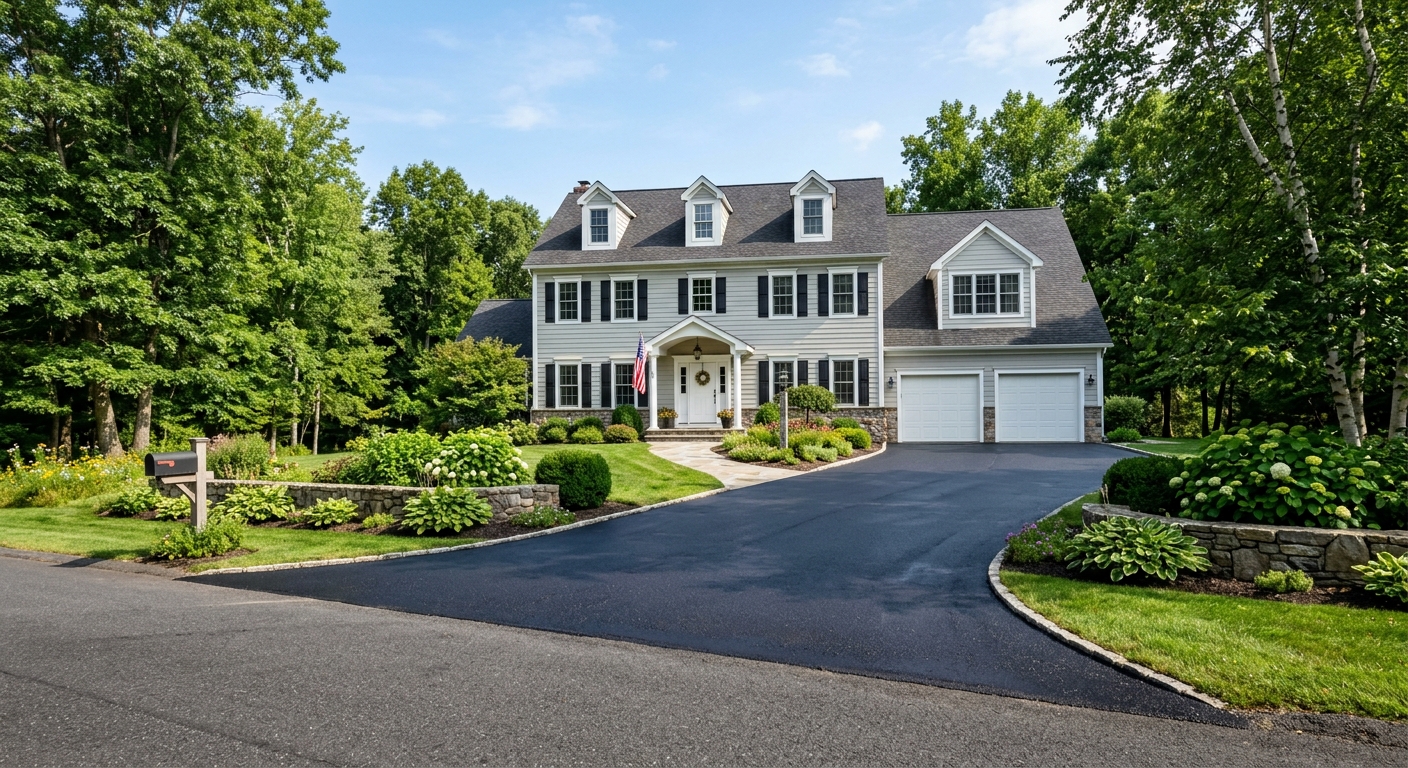
What a new driveway costs in Mount Carmel
Mount Carmel is a town where driveways are a homeowner’s concern — 70.3% of households own their homes, and about a third are single-family properties (U.S. Census Bureau, ACS 2024). Around here, with freeze-thaw winters and shale-heavy subsoils, pricing for a new driveway isn’t just about the square footage or the top surface you see. The real cost is in what’s buried below — how deep the base is, how well water drains, and whether the soil was properly prepared. Two quotes may look similar on paper, but if one skips undercutting or base compaction, the lower price can mean problems within a few years.
Older river-town houses (89% built before 1980) often have driveways with weak edges or uneven base layers. With the highest snow loads in the state and a 36-inch frost depth, shortcuts beneath the surface show up in the winter, when water in the subgrade freezes and pushes upward. Mount Carmel price ranges below factor in local travel surcharges, the extra excavation needed for our glacial till, and the fact that hauling in aggregate or asphalt can stretch out costs.
| Service |
Best for |
Lifespan |
Price range |
| Asphalt — full replacement with new base |
failed base, structural cracking |
20–30 yrs |
$3,100–$7,900 |
| Asphalt overlay / resurfacing |
sound base, surface cracking only |
8–15 yrs |
$1,300–$4,000 |
| Sealcoating — single application |
preventive maintenance on sound asphalt |
2–4 yrs |
$175–$600 |
| Concrete — new installation |
long service life, low maintenance |
30–50 yrs |
$4,400–$10,500 |
| Crack filling and patching |
isolated cracks under a quarter inch |
1–3 yrs |
$200–$800 |
| Gravel driveway |
rural, budget, long runs |
5–10 yrs with upkeep |
$900–$3,500 |
Estimates for a typical Mount Carmel driveway. Square footage and base condition drive these figures more than material choice.
Choosing a paving company
If you’re investing thousands in a driveway in Mount Carmel, picking the right contractor is the most important decision you’ll make. Verifying their Home Improvement Contractor registration—searchable directly at hic.attorneygeneral.gov—is where you start. But don't stop there. In a rural market like Northumberland County, fly-by-night crews sometimes sweep into town with no local base, especially when asphalt plants are running at full tilt and aggregate supply is stretched. If a contractor can’t tell you which local quarry or batch plant supplies their asphalt, they’re probably brokering out your job rather than doing the work themselves—never a good sign.
Always ask for references from jobs done in Mount Carmel or nearby three or more years ago. A recently paved driveway will look fine after a day, but you need to see how it’s held up through freeze-thaw cycles. Make sure they provide a real street address (not just a mobile number) and their own equipment, not short-term rentals. In this part of the county, travel surcharges are common, but a reliable business should have familiarity with local base soils and drainage problems, as well as the actual source of their materials.
- Active HIC registration (verify at hic.attorneygeneral.gov)
- Workers’ compensation coverage (verify via WCAIS)
- References from jobs done at least 3 years ago nearby
- Local, physical business address
- Proof of owned paving equipment
- Confirmation of aggregate supplier and asphalt plant name
- Written, itemized contract per HICPA
- No requirement to pay cash upfront
- Full cost and payment terms in contract (HICPA)
- Insurance certificate issued to you
- Willingness to discuss base section and compaction in detail
- Knowledge of local soil and drainage issues
Red flags: out-of-town license plates, refusal to share supplier info, no paperwork, cash-only deals, or avoidance of written contracts. If they promise to waive your deductible or offer “leftover” asphalt at a big discount, walk away.
Caring for a new Mount Carmel driveway
Northumberland County’s winters are long and the conditions unforgiving. For your driveway, the number one thing you can do is control water and keep cracks filled. Before water gets through to the base, filling even a hairline crack prevents frost from lifting and breaking up the entire structure. Next, protect the driveway edges — unsupported edges crumble early, especially when snow plows ride up or delivery trucks cut corners. Where possible, add topsoil and seed up to the pavement, and don’t let tires hang over the edge.
Keep the area graded so water never sits or runs toward the house. Ditches, swales, or even a simple sloping broom finish at the surface all help. Never park dumpsters or use jack stands directly on asphalt — point loads will leave you with permanent dents or cracks, especially in the weeks after installation.
If you have a new asphalt driveway, don’t park on it for at least three days in the summer or longer if it’s cool — and avoid turning wheels while stopped for the first month. Concrete needs even more time before salting or placing heavy loads.
For winter maintenance, salt is risky for concrete in Mount Carmel’s climate; it accelerates surface spalling and shortens life. On asphalt, the concern is thaw/refreeze cycling. Alternatives like sand or calcium magnesium acetate work, but they cost more than plain salt. For many here, prompt shoveling is still the best (and cheapest) defense.
Diagnosing a failing Mount Carmel driveway
Each Mount Carmel driveway tells a story in the cracks and patches. Around here, with postwar housing and old subgrades, most real damage starts beneath the surface. You can diagnose a lot yourself before calling a contractor. Alligator cracking across larger areas (a network of small, blocky cracks) is a sign the base is shot — no overlay can help. If you only see a few straight cracks, especially at the joints or edges, those might just need sealing. Depressions and birdbaths show that the subgrade or the original base has shifted or settled, usually because of water and shale pockets.
Potholes and crumbling edges almost always mean water got below, or the edge was never given proper support. If an estimator says an overlay will fix base failure, they either haven’t checked properly, or they’re hoping you won’t know the difference — and that’s money wasted. The only correct way to confirm a sound base is by physically probing or cutting a few test areas to see what’s below.
| What you see |
Likely cause |
Right fix |
Cost |
| Isolated cracks under 1/4 inch |
surface aging |
crack fill and seal |
$175–$600 |
| Alligator cracking over a wide area |
base failure |
full replacement |
$3,100–$7,900 |
| Depressions holding water |
subgrade movement |
excavate and rebuild that area |
$3,100–$4,800 |
| Crumbling edges |
no edge support |
edge repair, consider curbing |
$400–$1,500 |
| Potholes |
water into the base |
full-depth patch, then assess |
$250–$900 |
| Faded but sound surface |
oxidation only |
sealcoat |
$175–$600 |
What's under the asphalt matters more than the asphalt
Paving in Mount Carmel (and all of Northumberland County) is first about what’s under the blacktop. The proper driveway assembly starts with your subgrade — the natural soil, often glacial till and shale around here. That gets undercut and compacted to remove soft spots. Then comes the aggregate base, typically 6–8 inches of crushed stone, spread in layers (called “lifts”) and compacted hard. Finally, asphalt is laid over top. Each layer transfers load down — so if the subgrade gives way, your asphalt cracks no matter how thick it is.
Freeze-thaw cycles are brutal. Our frost depth runs 36 inches in a typical winter, so if water is trapped in the ground, it freezes, expands, and heaves sections upward. This cracks asphalt and concrete from below. That’s why proper base depth, crushed stone (not gravel or fill dirt), and prepping for drainage are essential, not optional. Skipping just a few inches of stone, or spreading it loose instead of compacting, saves money…at first. But what fails is invisible up front. In year three, the thin-section job will start cracking and settling — exactly when you’re out of warranty.
To protect yourself, always demand in writing: the depth of undercut and base excavation (in inches), type of aggregate (example: 2A modified stone), minimum compacted base thickness (say 6–8 inches), and that compaction is done in lifts (not all at once). Ask how they test for compaction — a plate compactor is not enough if your subgrade is soft or wet. In Mount Carmel, an honest contractor will specify all this as part of the standard contract.
Drainage: the failure nobody plans for
Water causes nearly every driveway failure here in Mount Carmel. Proper grading isn’t cosmetic — it is the only real defense. Your driveway should slope away from buildings and never let water stand for more than a few hours. The minimum surface slope to shed water is 2%, or about a quarter inch per foot. Wide driveways may use a crowned profile (high in the center) or a cross-slope, but either way, runoff must flow to the street or to dedicated drainage, not toward the garage or house foundation.
If the ground falls toward the garage or cannot be regraded, trench drains or channel drains across the entrance let you intercept water and pipe it to a safe outfall. Around here, shale and glacial till soils don’t drain quickly — heavy clay pockets hold water at the base, increasing freeze-thaw damage if not managed by proper grading or buried drainage tile.
Avoid redirecting your runoff onto the neighbor’s lot. That’s a liability issue in Northumberland County even if you could win an argument with the city. If the slope won’t carry water to daylight (a natural low point at the curb), a dry well or properly sized gravel pit may be needed to keep water from lingering around your base.
The bottom line: if water stands or pools, especially anywhere the base was disturbed or fill was added, you’ll see heaving and cracks within a few winters.
Driveway permits, approaches and stormwater rules
For most Mount Carmel homeowners, repaving an existing driveway — as long as you’re not changing its footprint — does not trigger a building permit requirement. The Pennsylvania Uniform Construction Code (UCC) doesn’t typically get involved unless your project changes the size or drainage pattern significantly.
However, your driveway approach (where it meets the public road) is another matter. In Northumberland County, if your driveway connects to a state highway, you’ll need a permit from the PennDOT District 3 maintenance office — not the local city office. Even for repairs or complete replacement, approach permits are the rule for state routes.
If you’re expanding or adding a new driveway, you may face stormwater rules: adding impervious surface can require a plan to keep runoff on your property. Pushing runoff onto a neighbor — even with a permit in hand — creates liability and could get you into a dispute.
Contractors in Mount Carmel must have an active Home Improvement Contractor registration (check at hic.attorneygeneral.gov) for contracts over $500, plus active workers’ compensation coverage (verify via WCAIS). Always get your contract in writing, as required by the Home Improvement Consumer Protection Act.
Frequently asked questions — driveway paving in Mount Carmel
How thick should asphalt be for a residential driveway in Mount Carmel?
For Mount Carmel, with its deep frost line and frequent freeze-thaw cycles, asphalt thickness is not something to skimp on. The standard for this part of Pennsylvania is 2–2.5 inches of compacted topcoat for standard cars, but you want at least 3 inches total in two layers (base and surface) for anything larger or if you regularly see delivery vehicles. More important, the stone base underneath should be 6–8 inches thick, compacted in layers. So if you’re being quoted an overlay at $1,300–$4,000, check whether any additional base repairs are included; otherwise, you may be buying a surface that won’t last.
Are pavers worth the cost in north-central Pennsylvania?
In Mount Carmel, pavers are rarely installed for driveways, and for good reason. While they can look attractive and offer impressive lifespans, the upfront cost is often double or more compared to standard concrete or asphalt. Our region’s heavy frost heave and snow loads (40 psf) mean pavers require an even thicker and better-drained base to avoid shifting and heaving. If you want minimal maintenance in north-central Pennsylvania, a full-depth asphalt replacement ($3,100–$7,900) or concrete installation ($4,400–$10,500) is more cost-effective, holds up with fewer repairs, and deals better with the local freeze-thaw cycles.
How many freeze-thaw cycles does Mount Carmel get?
Mount Carmel is in one of Pennsylvania’s most punishing climates when it comes to freeze-thaw action. The region typically cycles between freezing and thawing dozens of times each winter due to regular temperature swings, with a winter design temperature down to 2°F and a frost depth of 36 inches. This increases the risk of driveway damage—especially for base layers not built for movement. That’s a big reason why local paving costs, such as a full asphalt replacement at $3,100–$7,900, are governed less by surface material and more by base preparation and drainage.
Why are paving quotes in Mount Carmel so different from each other?
The range in paving quotes around Mount Carmel mostly comes down to what’s happening below the surface and the realities of the local market. Materials come from local quarries and asphalt plants, but haul distance can still add to your bill. Some companies skip base repair, undercutting, or compaction to appear much cheaper—things you won’t see until it’s too late. Older homes here (most built before 1980) can hide all sorts of subgrade problems that must be fixed for a driveway to last. Always scrutinize what your quote includes: $3,100–$7,900 might cover a proper dig-out, while a “too good to be true” bid skips the step, leading to failure by the third winter.
When can I seal a brand new asphalt driveway?
For Mount Carmel and most of Pennsylvania, you need to wait for the asphalt to properly cure before applying a sealcoat. Most contractors recommend waiting a full season—often 6 to 12 months—so that new asphalt can harden and the oils can release. Sealing too early can trap those oils, leading to soft spots and premature cracking. Scheduling your first maintenance sealcoat after the first winter (typically at $175–$600) gives better, longer-lasting results. If you see any cracks or scuffs during the first year, address those first; don’t rush the job.
When is the best time of year to pave in Mount Carmel?
The best time to pave in Mount Carmel is late spring through early fall, when temperatures are reliably above 50°F and the ground is dry. Paving in the colder months or early spring means the asphalt might not compact and cure properly and the base could still be wet from winter thaw. Since our average heating degree days are high and we deal with the highest snow loads in Pennsylvania, it’s smart to book early to avoid delays. Contractors will also have an easier time sourcing material, which keeps your job within the typical $3,100–$7,900 range for a full asphalt replacement.
What causes driveway cracks in Mount Carmel?
Most cracks in Mount Carmel driveways start with water and freeze-thaw cycles. As water seeps into openings—whether they’re from wear, UV damage, or poor drainage—it freezes and expands, popping cracks open wider each year. Our shale and glacial till soils can shift with moisture, pushing the base up and down. Older driveways without proper edge support or with neglected cracks will see failures sooner. Sometimes, tree roots or heavy trucks parked in one spot speed up the process. Preventive crack filling (typically $200–$800) is the cheapest fix and slows down long-term damage in our climate.
How much does it cost to widen a driveway?
In Mount Carmel, widening a driveway means not just laying new surface, but also excavating, adding stone base, and correcting drainage. The cost depends on how much you’re adding, but figure on rates comparable to new base installation—often $3,100–$7,900 for a full-width addition. If only a small section is being widened and the subgrade is already stable, the lower end is possible, but most older properties here uncover surprises: shale pockets, soft fill, or previous edge erosion. Ask your contractor for a line-item estimate to see exactly what’s included for the price.
Do I need an approach permit where my driveway meets the road?
Yes—if your Mount Carmel driveway meets a state road, you’ll need a permit from the PennDOT District 3 maintenance office for any approach work, even if you’re just replacing what’s there. This is separate from city or borough rules and is enforced strictly across Northumberland County. Approach permits are there to ensure drainage, safety, and sightlines are handled correctly. Permits usually aren’t needed for repaving the driveway inside your property line unless you’re changing the footprint or drainage. If your approach needs rebuilding, this can factor into your total replacement cost (often $3,100–$7,900). Always check before work starts to avoid fines or forced removals.