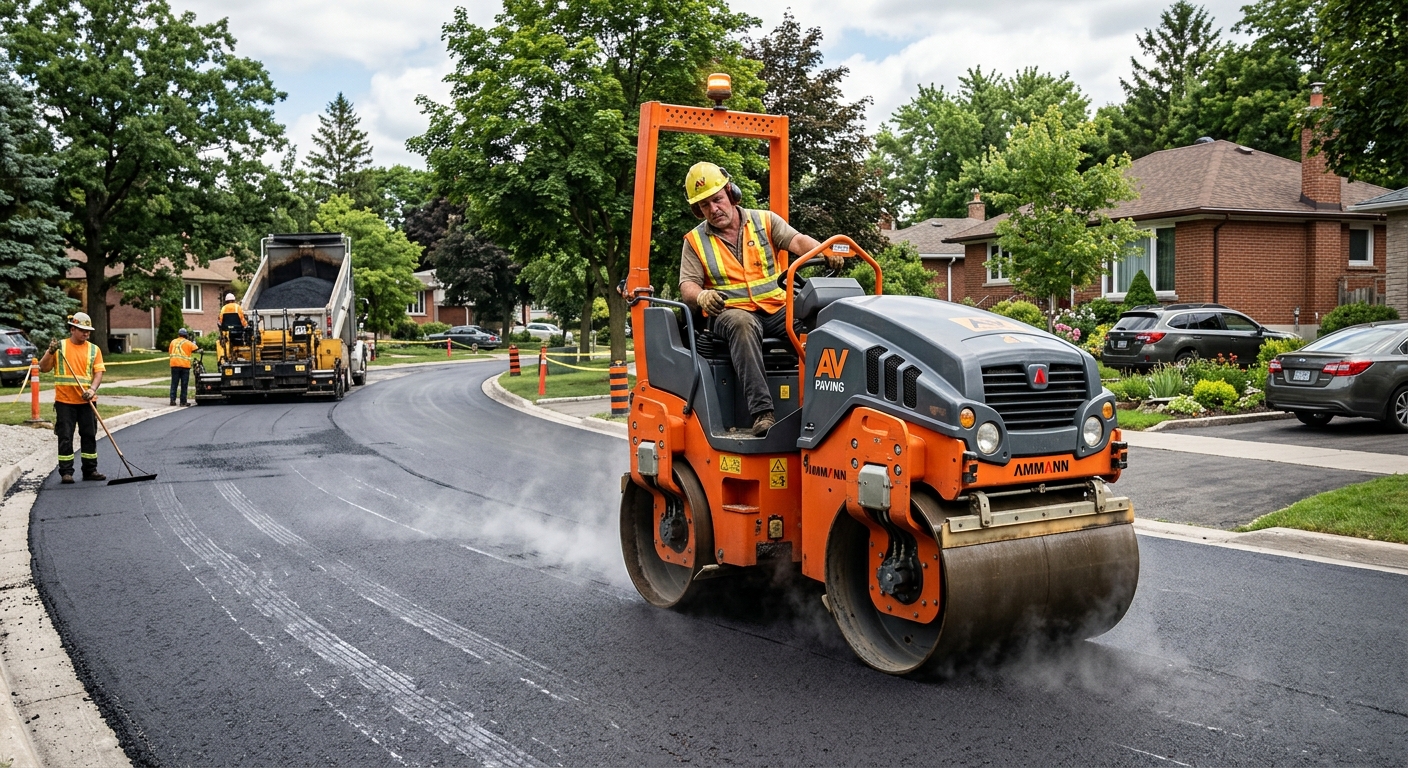
What a new driveway costs in West Vincent
In West Vincent, where 84.1% of homes are single-family and the homeownership rate stands at 84.0% (U.S. Census Bureau, ACS 2024), driveway paving is an investment most owners eventually face. Whether you’re replacing an aging asphalt drive or considering an upgrade, costs here reflect both the suburban market and our southeastern Pennsylvania climate — which brings freeze-thaw cycles and requires real attention to what lies beneath the finished surface. In Chester County, many driveways built in the 1960s–1980s are now due for full-depth replacement rather than a simple resurfacing, especially if the base is failing.
The price spread you’ll see between quotes is often about more than material or square footage. In this region, the subgrade sits over limestone and dolomite, both of which demand extra attention to base thickness and compaction to avoid future cracking. Most of what you pay for in a new driveway is hidden: excavation, base installation, grading, and drainage. Two bids with a several-thousand-dollar difference may look identical day one, but three winters later only one might hold up — and that difference is under the surface, not the asphalt you see.
| Service |
Best for |
Lifespan |
Price range |
| Asphalt — full replacement with new base |
failed base, structural cracking |
20–30 yrs |
$4,500–$11,500 |
| Asphalt overlay / resurfacing |
sound base, surface cracking only |
8–15 yrs |
$1,950–$5,800 |
| Sealcoating — single application |
preventive maintenance on sound asphalt |
2–4 yrs |
$250–$900 |
| Concrete — new installation |
long service life, low maintenance |
30–50 yrs |
$6,400–$15,500 |
| Crack filling and patching |
isolated cracks under a quarter inch |
1–3 yrs |
$200–$800 |
| Gravel driveway |
rural, budget, long runs |
5–10 yrs with upkeep |
$900–$3,500 |
Estimates for a typical West Vincent driveway. Square footage and base condition drive these figures more than material choice.
Base preparation: the part you pay for and never see
The most critical part of a driveway in West Vincent, and the one no homeowner ever admires, is what happens below the surface. Every driveway starts with the native soil — in central Chester County, that often means limestone or dolomite bedrock, which demands thickness and good drainage to avoid settlement and reflective cracks. On top of the subgrade, contractors build up a compacted aggregate base, usually crushed stone, before the final asphalt surface goes down. Each layer is supposed to do a job: spread the weight, support the loads above, and channel water away.
Freeze-thaw cycles, which are a given in this part of Pennsylvania, pose a special threat. When water sits in the subgrade and freezes, it expands, lifting sections of the driveway unevenly (this is frost heave) and eventually cracking the surface from underneath. Thin base layers or poor drainage let this cycle repeat, shortening driveway life to a handful of years. That’s why Chester County installs typically require a thicker aggregate base — 6 to 8 inches minimum is not excessive here — and dense compaction, never just raked in and covered over.
This is how a cheap paving quote stays cheap: little or no excavation, thinning the base, skipping compaction, and covering a failing bed with two inches of asphalt. The flaws are invisible on day one, but three winters later, you’ll see crumbling edges, dips, cracks, and even potholes. If you take one thing from this, insist that your contract spell out:
- Aggregate base: At least 6 inches of compacted crushed stone for West Vincent’s soils
- Compaction: Base installed and tested in multiple lifts, not in one pour
- Drainage: Clear plan for water to exit the driveway, not pond or flow to structures
If those aren’t in writing, you’re gambling the most expensive part of your driveway on a handshake.
Overlay, patch or full replacement?
Before you call anyone, there’s a self-check that can save you a lot of second-guessing — because the right fix depends on base condition more than surface appearance. In West Vincent, many older driveways have aged past what an overlay or simple patch can fix. Here’s how you can tell:
- Alligator cracking (a patchwork of cracks over a wide area) almost always means the base has failed. Overlaying won't solve it — you need a full replacement, or the problem just repeats.
- Linear, isolated cracks typically signal surface aging. These can be cleaned, filled, and sealed. No reason to tear everything out.
- Depressions or “birdbaths” that hold water point to subgrade movement below. Patching might smooth things over, but unless the underlying base is excavated and rebuilt, expect more trouble.
- Edge crumbling usually means the driveway was built with no shoulder or curb to support traffic. Loss of side support is a construction issue that can often be repaired.
- Potholes mean water has already worked down to the base, requiring full-depth patches at minimum; if widespread, it may be time for a full redo.
If someone offers an overlay without probing the base (by coring or at least chipping), you aren’t getting a real diagnosis. An overlay over a bad base is money burned, plain and simple.
| What you see |
Likely cause |
Right fix |
Cost |
| Isolated cracks under 1/4 inch |
surface aging |
crack fill and seal |
$250–$900 |
| Alligator cracking over a wide area |
base failure |
full replacement |
$4,500–$11,500 |
| Depressions holding water |
subgrade movement |
excavate and rebuild that area |
$4,500–$7,100 |
| Crumbling edges |
no edge support |
edge repair, consider curbing |
$400–$1,500 |
| Potholes |
water into the base |
full-depth patch, then assess |
$250–$900 |
| Faded but sound surface |
oxidation only |
sealcoat |
$250–$900 |
Why you can't pave in February
Paving is not a year-round business in West Vincent. Our region’s winter design temperature dips to 14 °F, and even with 4800 heating degree days, it’s not just uncomfortable — it’s impossible to get a quality result when the weather is wrong. Hot-mix asphalt must be installed and compacted while it’s hot. Below about 50 °F air temperature, the mix cools far too quickly for proper compaction, which means the driveway ends up porous, weak, and short-lived. Local asphalt plants actually shut down for the season, so in winter, the material isn’t even available.
Concrete has its own constraints — it needs to cure above freezing. Pouring when there’s a risk of frost leaves you with scaling and surface failure down the road. For Chester County, paving season runs from mid-April to early November most years, stretching later only if fall temperatures hold (which isn’t something to count on).
In practice, the busiest time for paving crews is summer. September and October often bring the best combination of contractor availability and good weather. If a company offers to pave in December — or promises a “winter special” — understand you are being offered a shortcut and will likely pay for it in repairs.
Sealcoating: what it does and what it doesn't
Sealcoating is one of those maintenance items that’s never as simple as it sounds, especially here in Chester County where conditions swing from humid summers to freezing winters. What does sealcoating actually do? When properly applied, it helps slow oxidation of the asphalt binder by keeping out air and UV, resists fuel and oil spills, and gives the surface a uniform look. That’s it. What sealcoating does not do is add structural strength, “bind cracks,” or restore a base that’s already failing. And it does not meaningfully lengthen the lifespan of a driveway with deep cracks or soft spots underneath.
Overapplication is a real risk: layering sealer too often (more than every three to four years) can build up to the point that you get surface cracking and peeling, which actually makes the driveway look worse and traps moisture against the surface. Applying sealer to fresh asphalt before the oils have cured (often 90 days to a full summer season here) locks in volatiles and leads to premature failure.
The maintenance that really matters is crack filling — routing out and sealing cracks before water gets in. That’s what keeps freeze-thaw from tearing up your base in a Chester County winter. A brush-applied, two-coat seal is what you want, not a dip-and-spray that barely darkens the surface. Pricewise, expect a single application to run $250–$900. If you’re quoted less, you’re likely getting thin, watered-down material that won’t last through a season.
What you need before paving in West Vincent
For most driveways in West Vincent, you don’t need a building permit to repave or resurface your driveway as long as you’re staying within the existing footprint and not working in the public right-of-way. That’s a common relief for homeowners — but if you’re expanding, changing the layout, or connecting to a public road, different rules apply. Any driveway where it meets a state route will require a Highway Occupancy driveway approach permit from PennDOT Engineering District 6-0, not just a township approval.
If you’re in a township that borders public roads, check whether your local code office has additional permit requirements, especially for new driveways or expansions. Regardless of permits, remember: expanding the area of paving can create stormwater runoff liabilities. It’s your responsibility to avoid draining water onto the neighbor’s land, and impervious coverage limits may apply even if no permit is required.
Every contractor on a job over $500 must have a Home Improvement Contractor (HIC) registration issued by the Pennsylvania Office of Attorney General (verify at hic.attorneygeneral.gov), and must be insured for workers’ compensation (verify at wcais.pa.gov). Do not sign a contract without seeing these — it’s both a matter of law and basic protection.
Which surface survives West Vincent winters
In West Vincent, freeze-thaw cycles and humid summers make driveway material choice a real consideration. Asphalt shines in our region because it flexes under ground movement — when the limestone subgrade shifts or water expands and contracts, asphalt stretches slightly, tolerating far more abuse from winter than concrete does. That’s why most driveways here are asphalt: it simply handles Pennsylvania winters better.
Concrete, while more expensive up front, can last decades longer if it isn’t attacked by de-icing salts. But that is exactly the issue in Chester County. Salt-based de-icers — a winter staple — cause concrete to spall and scale, not so much to crack. Even when poured perfectly, a few harsh winters with road salt can leave patchy, rough sections and flaking that ruins the appearance.
The honest trade is this: concrete is for the rare homeowner who can skip de-icing salt and commit to prompt snow removal. Most folks don’t keep to that, and asphalt ends up the lower-risk bet. For long runs or rural properties, gravel remains the lowest upfront cost and drains well, though the visual and maintenance requirements aren’t for everyone. Pavers are a premium choice here, offering the best of both worlds, but come at a higher price.
| Option |
Installed cost |
Maintenance |
Freeze-thaw performance |
Lifespan |
| Asphalt — new install |
$4,500–$11,500 |
sealcoat every 3–4 yrs |
excellent, flexes |
20–30 yrs |
| Asphalt — overlay |
$1,950–$5,800 |
same |
good if base is sound |
+8–15 yrs |
| Concrete |
$6,400–$15,500 |
low, avoid de-icing salt |
fair, spalls with salt |
30–50 yrs |
| Pavers |
$10,500–$15,500 |
individual units replaceable |
good, settles gradually |
25–50 yrs |
| Gravel |
$900–$3,500 |
top-dress every 2–3 yrs |
excellent drainage |
indefinite with upkeep |
Frequently asked questions — driveway paving in West Vincent
What is the difference between binder and surface course?
The binder course and surface course are two layers of hot-mix asphalt, each with a different role in a West Vincent driveway. The binder course is installed first over the compacted aggregate base; it’s thicker and coarser, built to take the main load of vehicles and resist minor ground movement, which is essential with our freeze-thaw cycles and limestone soils. On top of that goes the surface course (also called the “wearing course”), which is finer, smoother, and provides the finish you see and drive on. This top layer resists sunlight, rain, and daily use. If you’re quoted a bargain price in Chester County, make sure you know how thick each layer will be, and insist on seeing it in the contract. Typical cost for a full proper installation here runs $4,500–$11,500 for asphalt, and skipping either step is a false saving.
Why are paving quotes in West Vincent so different from each other?
Quotes for driveway paving in West Vincent can swing by thousands because most of the cost is in what you can't see — excavation, base thickness, drainage, and compaction. Some contractors cut corners on base prep, using less stone, compacting too quickly, or skipping excavation if the old base has failed. These all reduce their costs up front but leave you with a driveway that might last half as long. For a typical Chester County home, a new asphalt driveway can range anywhere from $4,500–$11,500. Always insist that your contract lists the base depth and type, compaction method, and shows actual square footage. If what’s below the asphalt isn’t spelled out, that’s where corners can get cut.
Is gravel a cheaper option in West Vincent?
Yes, gravel is usually the least expensive choice for driveways in West Vincent, particularly for longer or rural drives. Installed cost for a gravel driveway typically runs from $900–$3,500, depending on length and grading demands. Gravel is very forgiving with drainage in this region's freeze-thaw cycles and limestone soils, but does require more frequent raking, weeding, and top-dressing – usually every two or three years – to keep it looking good and prevent ruts. It’s also dustier and not as clean for parking or kids’ activities. For homeowners who don’t mind some periodic upkeep, though, gravel gives years of use at much lower initial cost than asphalt or concrete.
Does road salt damage driveways in West Vincent?
Road salt is a real concern in West Vincent, especially for concrete driveways. The freeze-thaw climate and frequent de-icing mean salt accelerates scaling, pitting, and surface spalling in concrete, which can cut its life in half if you aren’t careful. Asphalt is less susceptible, but heavy salting can still contribute to surface wear and cracking over time. For concrete, avoiding salt or using alternative ice melters is critical – otherwise your investment, which can be $6,400–$15,500 for a new install, may not pay off with decades of service. Asphalt tends to flex and recover, which is why it’s more popular in Chester County for winter durability.
How long does a driveway installation take?
For a typical single-family home in West Vincent, a new asphalt driveway installation (including excavation, base, and paving) usually takes two to three days, with time split between prepping the base, compacting stone, and installing the binder and surface courses. Concrete installations take a day or two to pour, but must cure for several days before any traffic. Factors that add time include poor weather, complex layouts, or major base repairs. Don’t be swayed by anyone promising a completed job in one day if they include both removal and new installation — in Chester County, a rushed or poorly compacted job is likely to fail in a few years. The range for a proper install is $4,500–$11,500 for asphalt, and time should not be shaved at the expense of curing or compaction.
Why are my driveway edges crumbling?
Crumbling edges are a common problem for driveways in West Vincent and throughout Chester County. This usually happens when the asphalt or concrete was installed without enough base material extending beyond the paved surface, leaving the edges unsupported. Cars that drive or park too close to the edge cause the unsupported material to fracture, snap, and eventually crumble away. The solution is to rebuild the edge with sufficient stone base underneath and consider installing a curb or adding topsoil and grass right up to the edge for support. Fixing edges typically costs $400–$1,500, depending on the extent and whether curbing is added.
When can I seal a brand new asphalt driveway?
In West Vincent’s climate, you want to wait at least 90 days (sometimes a full summer season) before applying any sealcoat to new asphalt. That gives the driveway time to “cure” — this means excess oils evaporate and the surface hardens, otherwise, sealing too soon locks in volatile compounds that can lead to soft spots and premature failure. Given our humid, moderate climate, the safe bet is to hold off until the next sealing season after paving. A proper single application of sealcoat runs $250–$900 in Chester County, and there’s simply no benefit to rushing it before the asphalt has aged a bit.
Can I cancel a paving contract I signed at my door?
Yes. Pennsylvania’s Home Improvement Consumer Protection Act (HICPA) gives you a three-business-day right of cancellation for any written home improvement contract over $500 — including driveway paving — if it was signed at your home. The contractor must provide you this notice in writing. If they do not, the contract isn’t legally enforceable until they do. Cancel in writing (email or certified mail is best) and keep a copy for your records. Don’t let anyone push you into hasty decisions – a legitimate contractor in Chester County knows and follows this law for any project above $500, whether it’s asphalt, concrete, or other major work.
Asphalt or concrete for a West Vincent driveway?
Asphalt is usually the best fit for most West Vincent homes due to its flexibility in freeze-thaw conditions and resistance to de-icing salt — and upfront costs are lower, typically $4,500–$11,500 compared to $6,400–$15,500 for concrete. Asphalt handles movement from limestone soils, flexing where concrete might crack or spall under similar stresses. Concrete lasts much longer but demands scrupulous avoidance of salt and prompt snow clearing, or you risk surface damage in just a few years. Both require a solid base and good drainage, but for most Chester County families, asphalt delivers dependable service with more forgiving maintenance and lower cost to repair or replace sections later on.