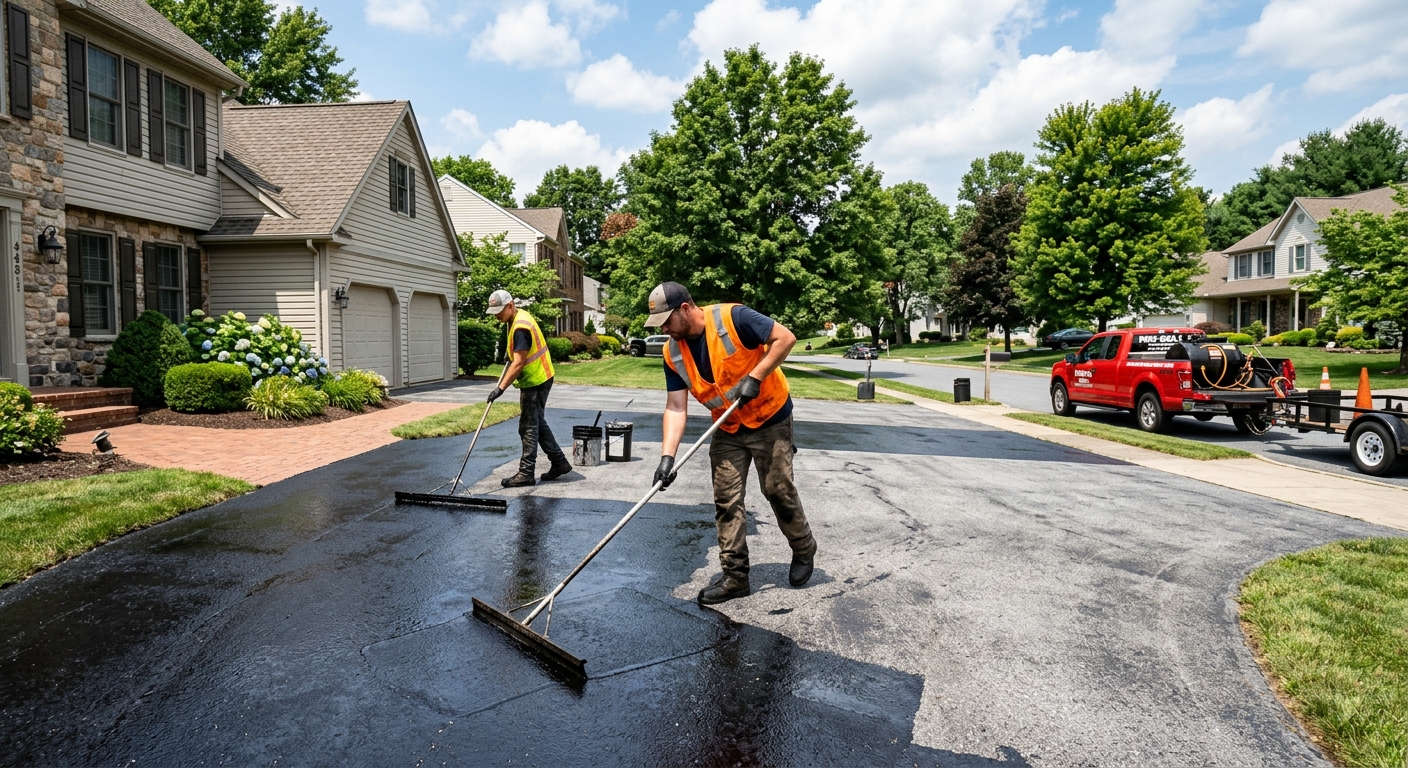
Driveway paving costs in Brentwood — 2026
In Brentwood, most homeowners own single-family houses, and over 64% of households own their property (U.S. Census Bureau, ACS 2024), so driveway paving is a real and recurring expense. With nearly all local homes built before 1980, decades of freeze-thaw cycles have taken a toll on driveways. The tough local climate—frequent winter swings, clay and shale soils, and deep frost—means what happens under the surface of your driveway is what dictates both the cost and how long it lasts. While you’ll see the blacktop or concrete, you’re really paying for the excavation, aggregate base thickness, and careful compaction that prevent heaving, potholes, and cracks. That’s why one paving quote can be thousands higher than another for the same square footage—it’s the unseen work that counts.
Contractors bidding at the low end often skip steps underground, running a risk that hidden problems with drainage or subgrade will surface in a few years. In contrast, the right build—especially over Brentwood’s heavy clay and shale subsoil—lasts much longer, even though you won’t see the difference right away. Below are estimated price bands for common options:
| Service |
Best for |
Lifespan |
Price range |
| Asphalt — full replacement with new base |
failed base, structural cracking |
20–30 yrs |
$3,300–$8,500 |
| Asphalt overlay / resurfacing |
sound base, surface cracking only |
8–15 yrs |
$1,400–$4,200 |
| Sealcoating — single application |
preventive maintenance on sound asphalt |
2–4 yrs |
$200–$650 |
| Concrete — new installation |
long service life, low maintenance |
30–50 yrs |
$4,700–$11,500 |
| Crack filling and patching |
isolated cracks under a quarter inch |
1–3 yrs |
$200–$800 |
| Gravel driveway |
rural, budget, long runs |
5–10 yrs with upkeep |
$900–$3,500 |
Estimates for a typical Brentwood driveway. Square footage and base condition drive these figures more than material choice.
Which surface survives Brentwood winters
Brentwood’s winters are rough on driveways, with freeze-thaw cycles and 8°F design temps. Asphalt is built for these conditions. It’s flexible, so the freeze-thaw movement of our local clay and shale soils doesn’t crack it the way it does rigid materials. When the ground heaves a bit, asphalt will flex slightly and settle back, making it a proven performer here for two or three decades if maintained.
Concrete is tempting for its long service life—30 to 50 years isn’t unusual in mild regions—but in southwestern Pennsylvania, road salt and the freeze-thaw cycle are its real enemy. Salt drives spalling and scaling, and most owners can’t avoid using de-icers on a sloped driveway or apron. Once that starts, patches don’t last long. Concrete works if you can commit to avoiding salt entirely, but that’s rare in Brentwood’s winters.
Paver driveways are robust and flex individually, making them viable on complex grades, but they cost more up front. Gravel is still the right answer for long rural runs and driveways without municipal aprons—it drains better than anything else, and upkeep is simple, but it’s not the norm for most Brentwood suburbs.
| Option |
Installed cost |
Maintenance |
Freeze-thaw performance |
Lifespan |
| Asphalt — new install |
$3,300–$8,500 |
sealcoat every 3–4 yrs |
excellent, flexes |
20–30 yrs |
| Asphalt — overlay |
$1,400–$4,200 |
same |
good if base is sound |
+8–15 yrs |
| Concrete |
$4,700–$11,500 |
low, avoid de-icing salt |
fair, spalls with salt |
30–50 yrs |
| Pavers |
$7,500–$11,500 |
individual units replaceable |
good, settles gradually |
25–50 yrs |
| Gravel |
$900–$3,500 |
top-dress every 2–3 yrs |
excellent drainage |
indefinite with upkeep |
Why you can't pave in February
Paving in Brentwood is not just a matter of weather preference—it’s dictated by the real constraints of our southwestern Pennsylvania climate. Asphalt must be hot when it’s laid and compacted, and below about 45°F surface temp, it loses workability in minutes. With winter design temperatures that dip to 8°F, there’s no way for crews to get a lasting bond: the mix cools too fast, doesn’t seal to the base, and breaks down in short order. To drive the point home, area asphalt plants shut down completely from late November through much of March. The material just doesn’t exist locally in winter.
Concrete faces its own hurdles. It needs to cure above freezing—not just for a day, but for the better part of a week—or it won’t get to full strength. While additives can help stretch the season a little, they are no fix for a deep freeze. In practical terms, Brentwood’s paving season runs late March through October in a typical year. The front and back ends are when you’ll find better crew availability and less rush. A company offering to pave your driveway in late fall or winter here is not doing you a favor—chances are, the job will not last through the next season’s freezing and thawing.
What you need before paving in Brentwood
Most repaving jobs in Brentwood—if they stay within the original driveway footprint and don’t alter the curb or apron—don’t need a building permit. That saves most homeowners a bureaucratic step. But be careful at the street: if your driveway ties into a state route, the approach needs a Highway Occupancy Permit from PennDOT District 11-0, not the borough office. For driveways connecting to borough-maintained streets, local rules apply; ask specifically about approach work if you plan to widen or relocate the driveway entrance.
Adding square footage to your existing driveway to create more parking can also trigger stormwater requirements. Expanding any impervious surface increases runoff, and Brentwood’s heavy clay subsoils make proper drainage essential to avoid damage to both your property and neighboring lots. Code or no code, you’re liable for runoff you direct across any property line.
Pennsylvania law requires contractors to hold a Home Improvement Contractor registration for any job over $500. You can verify this at hic.attorneygeneral.gov. Every contractor must also provide proof of workers’ compensation insurance. Double-check coverage through the state’s WCAIS system before the first shovel goes in—skipping this opens you up to liability if a worker is injured on your job.
How often should a Brentwood driveway be sealed?
Sealcoating is often oversold, but in Brentwood, it does serve a purpose. Applying a good sealer every few years slows asphalt oxidation, blocks spilled oil and gas from breaking down the binder, and makes your driveway look new for a while. What it will not do is add strength, fix alligator cracks, or keep base failures from showing. If the base is shifting, sealing is just makeup on the problem.
Sealing too often is a mistake—excess layers become brittle and start to flake off, especially with our freeze-thaw cycles. The same goes for sealing new asphalt too soon: the trapped volatiles can make the surface soft or sticky for months. A brand-new driveway should cure for at least 6–12 months before its first sealcoat, depending on the season of installation.
The maintenance that really matters is crack filling. Water getting into even small cracks undermines the entire structure. It’s worth filling cracks every year or two, especially just before winter. A proper sealcoat job involves cleaning, edge sealing, and hand-application in any critical areas—not just a fast spray on a hot day for a low price. Budget $200–$650 for a thorough seal, and be wary if you’re quoted much lower. That probably means it’s watered down or sprayed paper thin, which won’t stand up to Brentwood’s conditions.
Where the water goes
Water is responsible for just about every driveway problem I see in Brentwood. It sneaks into cracks, gets down into the sub-base, and, when winter hits, expands to break apart what’s above. The fix isn’t more paving—it’s good surface drainage from day one. Your driveway should pitch at least 2% away from the house or garage, or a quarter inch per foot, to get water off quickly. For a wide drive, a crown (high spot in the center) sheds water to both sides; for a narrow run, a cross-slope does the trick.
When the lay of the land puts your driveway sloping toward your home or garage door, standing water is almost guaranteed. In these cases, a trench drain or channel drain at the low end can save both your slab and your basement. Heavy clay soils, standard on Brentwood hillsides, hold water right against the base. That’s why a thicker aggregate base and solid side drainage—like daylighting pipes to a low point or, if there’s no slope, a dry well—are not optional here.
No matter what plan you follow, never direct water off your driveway onto the neighbor’s property. That opens up a liability issue you won’t fix with any permit or inspection. An extra hour spent thinking through drainage up front saves thousands later in repairs.
Choosing a paving company
Picking the right paver in Brentwood means more than checking for a flashy truck. Pennsylvania requires all paving contractors to hold a Home Improvement Contractor registration; verify it through hic.attorneygeneral.gov. For jobs with any employees, check for current workers’ compensation coverage on the state’s WCAIS system—don’t just take their word for it.
Beyond paperwork, a few specifics matter here. A legitimate driveway company will have a real business address you can drive past, not just a phone number. They own their core equipment—especially their roller, not just a truck and a subbed-in crew. Ask for references from projects in Brentwood or Allegheny County that are at least three years old. Drive by and look at how those driveways are holding up; fresh work means nothing in this climate. The company should name their Pittsburgh-area asphalt supplier—you’ll hear the same quarries and plants from anyone real. If not, it’s likely a broker who has no skin in the finished product.
- Check HIC registration at hic.attorneygeneral.gov
- Verify workers’ comp with WCAIS (wcais.pa.gov)
- Look for a local business address, not just a cell number
- Ask about owned equipment, not all rentals
- Get references from jobs 3+ years old in your area
- Drive by their previous work yourself
- Ask which asphalt plant or quarry they use
- Review a detailed, written estimate (not just a one-line price)
- No cash-only deals—get a contract, per state law
- Avoid contractors pushing “special low today” or “leftover asphalt”
- Company name should match all paperwork exactly
- Read online reviews, but don’t rely only on them
Red flags: out-of-area plates, high-pressure tactics, or quotes that seem noticeably lower than the local average likely mean corners will be cut—and with Brentwood’s winters, you will see the fallout rapidly.
Frequently asked questions — driveway paving in Brentwood
Why does my driveway have depressions that hold water?
Depressions or "birdbaths" in your Brentwood driveway almost always trace back to improper base preparation during construction or resurfacing. Our local heavy clay soils retain moisture, and if the base aggregate wasn't compacted in even lifts or if soft spots were not fully dug out, those areas settle with time—especially after winters with lots of freeze-thaw cycles. Surface patching helps but usually doesn't solve the underlying problem. Sometimes, depressions also result from heavy vehicles repeatedly parked in the same spot. For recurring trouble, the permanent fix is to cut out the low area down to solid base, rebuild it with fresh aggregate and hot-mix, and compact in lifts. For most homeowners, that localized repair falls in the $200–$800 range, but if there are many spots, or the pattern runs the length of the drive, it may signal you’re due for a full rebuild.
Can I cancel a paving contract I signed at my door?
Yes—under Pennsylvania’s Home Improvement Consumer Protection Act, any Brentwood homeowner who signs a contract for paving work at their home has a 3-business-day right of cancellation. Even if the contractor is registered and reputable, you’re not stuck immediately; the written contract must include a clear notice of this right. This gives you time to check references, compare options, or just change your mind. If you signed for work over $500 at your door or during a home visit, any reputable paver knows and expects you to exercise this right if you wish. Never feel bullied into quick decisions, and if a contractor tries to get you to waive your rights—or says “the price is only good today”—that’s your cue to walk away.
How much does driveway paving cost in Brentwood?
For a full asphalt replacement with new base on an average-sized Brentwood driveway, expect costs in the $3,300–$8,500 range. Resurfacing an existing drive (where the base is still good) is less, running $1,400–$4,200. Concrete is more durable but has a higher up-front cost of $4,700–$11,500. Prices are driven mostly by square footage and what needs done underground; our local freeze-thaw cycles and heavy soils mean it’s not worth skipping on base prep just to save money. Always demand a detailed quote so you know what foundation work is included.
When can I seal a brand new asphalt driveway?
In Brentwood, you need patience before sealing a new asphalt driveway—at least six months of warm weather, and sometimes up to a year. That’s because new asphalt contains oils (volatiles) that need to cure out, especially with our spring and summer humidity. Sealing too soon traps those oils, softens the surface, and can lead to peeling after the first winter. Wait until the rich black surface has faded to a lighter charcoal, signaling it’s ready to bond with sealer. Most reputable contractors recommend putting off sealcoating until the next summer. When you do get to it, the first application should be top-quality, not just a cheap spray; prices run $200–$650 for a real job.
What does compaction in lifts mean?
Compaction in lifts is the process of building up your Brentwood driveway in layers, with each layer (or "lift") of aggregate or asphalt being compacted before the next one goes on. This method ensures there are no voids or soft spots all the way from subgrade to surface—crucial here, with our region’s deep frost penetration and clay subsoils. Skipping this step, or laying material too thick at once, is a shortcut that leads to premature settlement, potholes, and heaving. Quality contractors will specify the number and thickness of lifts in their estimate, and it’s worth paying for. Reputable companies charging in the $3,300–$8,500 range for a new drive do it this way, while bargain quotes often skip it.
Should I repair or replace my Brentwood driveway?
If your driveway's surface has mild cracks but the base is still solid—meaning no major dips, heaving, or soft, spongy spots—resurfacing (overlaying) can buy you another 8–15 years of life and costs $1,400–$4,200. But if the damage runs deep, with large cracks, standing water, or obvious sinking, patching won't last. Brentwood’s heavy soils and frequent freeze-thaw cycles mean once a driveway fails structurally, repairing a few spots is just throwing good money after bad. In these cases, it makes sense to invest in a full replacement, digging down, compacting a new base, and doing it right so you don’t repeat the cycle again in five years.
How long before I can drive on a new asphalt driveway?
After a new asphalt driveway is paved in Brentwood, it’s best to wait at least 48 to 72 hours before driving on it in warm weather. Our typical spring and summer temps allow the surface to firm up quickly, but a few days of air-drying time is still necessary before the weight of a vehicle—even more if it’s hot and sunny. For concrete drives, the wait is longer—often a full week. Even after that, avoid heavy trucks, trailers, or sharp turns for a few weeks to prevent scuffing or rutting. Overlay jobs cure a bit faster, but it’s always worth playing it safe—good work at $3,300–$8,500 is an investment worth protecting.
What kind of soil is under Brentwood driveways?
Most Brentwood driveways rest on a mix of shale and clay soils, as is typical on Allegheny County hillsides. Clay holds water tightly, leading to slow drying—in contrast with sandier soils elsewhere. Shale fragments can shift as they weather and expand. This means our driveways need a thicker, well-compacted base to keep from heaving and cracking during freeze-thaw cycles. For new installations in the $3,300–$8,500 bracket, contractors spend the lion’s share of both time and materials below ground. If your old driveway shows a lot of cracking and movement, it’s nearly always a sign that the original builder cut corners on subgrade prep.
Why are paving quotes in Brentwood so different from each other?
The biggest reason for large swings in paving quotes across Brentwood comes down to what’s happening under the surface. Our local contractors all buy from the same Pittsburgh-area asphalt plants, but it’s the excavation and base prep that varies. On Brentwood’s clay and shale, some companies cut corners on base thickness or compaction to underbid, while others build for longevity. It’s easy to lowball with a thin overlay or minimal base, but that job won’t last through many freeze-thaw cycles. Quotes in the $3,300–$8,500 range for a full replacement mean the contractor is accounting for Brentwood’s drainage, frost depth, and soils. Anything much lower is a red flag—hidden shortcuts end up costing more down the road.