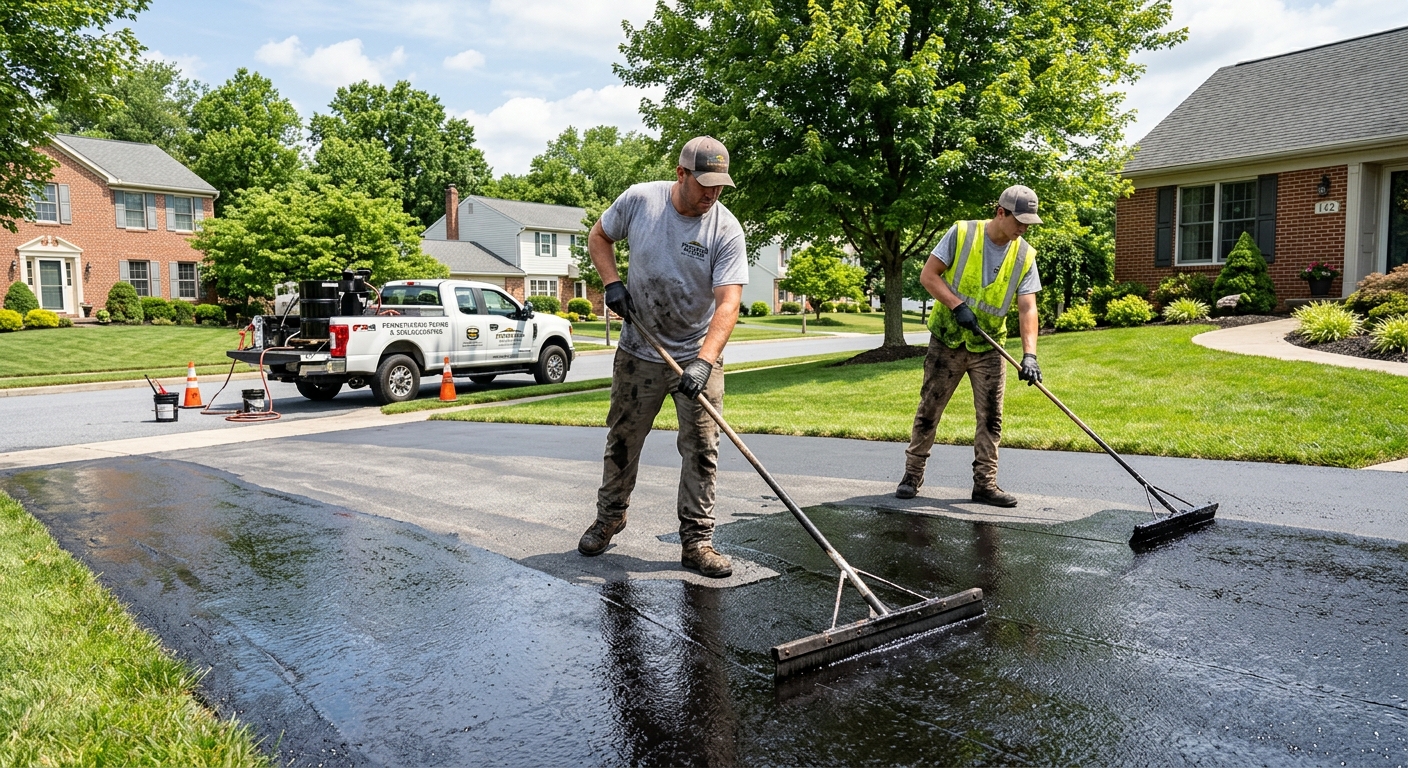
South Whitehall paving prices by scope — 2026
South Whitehall is dominated by single-family homes (71.3%), with a high homeownership rate of 80.4% (U.S. Census Bureau, ACS 2024). Most driveway work here is on private asphalt or concrete runs serving detached homes rather than apartment complexes or shared lots. The Lehigh Valley climate puts every driveway through repeated freeze-thaw cycles each winter, subjecting the base and surface to constant stress. Out west of South Whitehall, limestone in the soil can create voids, which means special care must be given to compaction and base thickness—if the subgrade shifts, the surface will crack no matter how thick the pavement.
Most cost variation in driveway quotes here comes from what you can’t see: the preparation or replacement of the stone base beneath the paving material. A full-depth replacement costs more because it removes unsuitable soil, adds substantial new stone, and compacts it to resist heaving. Asphalt overlay or resurfacing saves money by leaving the base untouched, but this only works if the subgrade is sound. Sealcoating and crack filling are low-cost maintenance, not structural fixes. Material prices are fairly stable because local quarries and asphalt plants serve the Lehigh Valley, so you’re rarely paying more for haul distance—what you pay for is expertise and prep.
| Service |
Best for |
Lifespan |
Price range |
| Asphalt — full replacement with new base |
failed base, structural cracking |
20–30 yrs |
$3,700–$9,500 |
| Asphalt overlay / resurfacing |
sound base, surface cracking only |
8–15 yrs |
$1,600–$4,700 |
| Sealcoating — single application |
preventive maintenance on sound asphalt |
2–4 yrs |
$200–$750 |
| Concrete — new installation |
long service life, low maintenance |
30–50 yrs |
$5,300–$12,500 |
| Crack filling and patching |
isolated cracks under a quarter inch |
1–3 yrs |
$200–$800 |
| Gravel driveway |
rural, budget, long runs |
5–10 yrs with upkeep |
$900–$3,500 |
Estimates for a typical South Whitehall driveway. Square footage and base condition drive these figures more than material choice.
Changing the footprint of a South Whitehall driveway
Many South Whitehall driveways are 1950s–1970s originals, sized for a single car. Widening for a second vehicle, adding length to reach a detached garage, or putting in a new turnaround is common as households add cars and want easier snow clearing. Converting gravel to asphalt, or putting in a parking pad, also counts as changing the footprint.
Anything beyond a straight replacement—meaning you’re expanding onto lawn or dirt—means the paving crew must excavate down to stable soil and build up a new base from scratch. The seam where old meets new is always a risk for future cracking because the old area settles differently than the addition. If you’re paving closer to your property line or adding coverage, township setback rules typically restrict how close you can get to a neighboring property or the street, and most South Whitehall lots have impervious-surface limits for stormwater control.
These changes can require stormwater management measures. The point where your driveway joins a public road—your approach—falls under township rules for local roads or, for state routes, PennDOT District 5-0. This review typically covers sight lines and runoff onto the public street. If your project changes the driveway’s drainage or increases runoff, expect to answer questions at permitting.
Where the water goes
In South Whitehall, water management is what keeps your driveway from failing before its time. Driveway grading is not just a finishing detail; it defines how long your investment will last. A slope of at least 1/4 inch per foot is needed to shed water off the pavement, with most runs crowned in the center or cross-sloped away from the house.
If your driveway slopes toward your garage or home, that’s a recipe for flooding and eventual base failure. Where grade cannot be changed—such as a walkout basement or low-lying lot—trench or channel drains intercept runoff and redirect it. Water that can’t drain off the driveway will seep below, especially in areas over limestone. When winter hits, this trapped water freezes, expands, and heaves up sections of surface. Each freeze-thaw—common in Lehigh County—puts another cycle of stress into the base, eventually leading to cracks, potholes, or even uplifts.
Redirecting runoff legally doesn’t mean you’re off the hook—sending your water onto a neighbor’s property opens you up to liability, even if the township signs off your project. Good drainage here often means running water to a daylighted slope, or to a properly sized dry well set on your own property. Driveways in western Lehigh County may need a thicker aggregate base and careful compaction, as limestone subgrade can shift if saturated.
Which surface survives South Whitehall winters
Asphalt and concrete both handle traffic, but northeastern Pennsylvania winters are the difference-maker. South Whitehall experiences repeated freeze-thaw cycles, plus regionally high snow and ice. Asphalt is a flexible surface that deforms slightly when the ground shifts under it—this helps it outlast concrete when winters are harsh and frost runs deep (here, the frost depth is 36 inches). Asphalt won’t crack just from movement, but it can rut if overloaded or if the base is thin.
Concrete, when installed over a perfectly prepped base, will last two to three times as long as asphalt. But it is unforgiving: concrete’s rigidity means any movement results in cracks, and here the big enemy is de-icing salt. Most South Whitehall homeowners (myself included) use salt during winter storms. Those chlorides attack concrete, causing spalling and surface scaling—failures you can’t fix except by replacement. So, concrete is only “lifetime” if you avoid salt, which few manage.
Pavers are great if you want an upscale look or need to repair small sections, and they handle freeze-thaw well by allowing slight settling. Gravel is still legitimate for long or rural runs—good drainage and indefinite life with routine dressing, though it’s not for steeper grades.
| Option |
Installed cost |
Maintenance |
Freeze-thaw performance |
Lifespan |
| Asphalt — new install |
$3,700–$9,500 |
sealcoat every 3–4 yrs |
excellent, flexes |
20–30 yrs |
| Asphalt — overlay |
$1,600–$4,700 |
same |
good if base is sound |
+8–15 yrs |
| Concrete |
$5,300–$12,500 |
low, avoid de-icing salt |
fair, spalls with salt |
30–50 yrs |
| Pavers |
$8,400–$12,500 |
individual units replaceable |
good, settles gradually |
25–50 yrs |
| Gravel |
$900–$3,500 |
top-dress every 2–3 yrs |
excellent drainage |
indefinite with upkeep |
How to vet a paving contractor in South Whitehall
Hiring a driveway contractor in South Whitehall means sorting true paving crews from brokers and fly-by-nights. Pennsylvania requires Home Improvement Contractor (HIC) registration for any paving contract over $500 (verify at hic.attorneygeneral.gov). Get written proof of workers' compensation through the WCAIS portal (wcais.pa.gov)—don’t take a verbal assurance. Ask for a local, physical business address. Paving outfits working full-time here have accounts at regional asphalt plants, not just rented equipment and out-of-state plates. A good contractor can tell you which local quarry or plant they buy from—if they can’t, you are probably getting a markup from a middleman, not a locally run job.
- Confirm HIC registration at hic.attorneygeneral.gov
- Obtain current proof of workers' compensation insurance via WCAIS
- Ask for a business address in the Lehigh Valley, not just a cell number
- Check references from driveways installed at least three years ago
- Ask for before-and-after photos of local jobs
- Request the name of their asphalt supplier or local quarry
- Confirm they own (not just rent) paving equipment
- Get a written contract as Pennsylvania requires above $500
- Require a scope listing base thickness and materials
- Never pay in full upfront—deposit of 10–30% is standard
- Ask about handling permit paperwork—avoid third-party brokers
- Review warranty terms in writing, not just a handshake
Red flags: door-to-door offers, insistence on cash, no written contract, out-of-state plates with no local address, or refusal to show insurance or registration. If a deal seems rushed, walk away.
What you need before paving in South Whitehall
For most South Whitehall driveways, if you're resurfacing your asphalt in the existing footprint, you generally do not need a building permit—that saves you paperwork and delay. But for any driveway approach, meaning where your driveway meets a public road, a permit is usually required. For state roads, this comes from PennDOT District 5-0; for local township roads, your township office handles it. Expanding the footprint or converting lawn to pavement almost always requires zoning or stormwater review, especially if you’re increasing impervious coverage.
Stormwater rules matter: adding pavement can mean new requirements for controlling runoff on your own property. Even with permits, you bear liability if increased runoff damages neighboring lots.
Contractors must hold valid Home Improvement Contractor (HIC) registration (verify at hic.attorneygeneral.gov) and carry workers' compensation insurance, which you can check in the WCAIS system (wcais.pa.gov). Be wary if they do not provide written proof. Pennsylvania law also guarantees you a written contract on any job above $500 and a three business-day right of cancellation.
The paving season in northeastern Pennsylvania
In the Lehigh Valley, paving season is dictated by temperature, not convenience. Hot-mix asphalt has a narrow working window: it must be laid and rolled while still hot, which is impossible once air temps reliably dip below the 40s, especially at night (local winter design temperature drops to 4 °F). Local asphalt plants close operations for the winter, making fresh asphalt unavailable for months.
Concrete is less tied to plant hours, but it still requires above-freezing conditions for curing—pouring when frost risk is present leads to surface problems and shortens lifespan. Both surfaces demand a stable, dry base, so even shoulder seasons can be tricky if it’s wet.
The best time for driveway paving in South Whitehall runs from late April through October, with prime conditions found from May through September. Shoulder months (late spring and early fall) see less crew backlog, and prices may be more competitive than the midsummer peak. If you’re quoted a job in late November or March, ask what plant is supplying the mix and how they plan to prevent rapid cool-down—in truth, any reputable outfit waits for appropriate weather. Don’t risk a rushed or out-of-season job; the price break never matches the repair bill later.
Frequently asked questions — driveway paving in South Whitehall
How many freeze-thaw cycles does South Whitehall get?
South Whitehall, like much of the Lehigh Valley, endures significant freeze-thaw cycling throughout winter—sometimes dozens of cycles each season. The frost depth here is 36 inches, and swings above and below freezing are frequent between November and March. These cycles are critical because each time water trapped below the driveway freezes, it expands and heaves upward, then contracts when thawed. This repeated movement breaks down both asphalt and concrete over time. In this region, even a well-installed driveway is competing against nature, so local crews always factor in the need for thicker aggregate bases and proper drainage. It’s not as snowy as the Poconos but severe enough that you can’t cut corners. Skimping on the $3,700–$9,500 investment for a full asphalt replacement will cost far more in early repairs if the base isn’t built to handle our particular freeze-thaw cycles.
What does an asphalt overlay cost in South Whitehall?
For a typical South Whitehall driveway, an asphalt overlay—often called resurfacing—costs between $1,600–$4,700 depending on square footage, existing base condition, and prep work needed. The most important factor is that the underlying base must be stable and free of significant soft spots or structural cracks; overlays merely cover the surface and do not correct deep issues. Overlay is a sound option on driveways where the worst trouble areas are minor and the entire run is not sinking or alligatored. Because most South Whitehall homes are single-family and date back to the 1950s–1970s, many driveways are due for at least resurfacing. Just don’t be sold on an overlay if the base is failing—it won’t last more than a few years if the underlying problems are not addressed.
How much does a concrete driveway cost in South Whitehall?
A concrete driveway installation in South Whitehall usually costs $5,300–$12,500 for a single-family lot, placing it at the premium end of local driveway options. Concrete lasts much longer than asphalt (often 30–50 years), but keep in mind it is more susceptible to spalling and scaling when de-icing salts are used—a common issue given our snow and ice exposure. While the upfront investment is higher, some homeowners prefer concrete for its finished look and low annual maintenance compared to asphalt. Still, unless you are scrupulous about winter salt use and quick snow removal, expect to see surface deterioration over time. If longevity per dollar is your goal and you’re not sold on the appearance, asphalt may give better value over 2 to 3 replacement cycles.
When is the best time of year to pave in South Whitehall?
The prime paving season in South Whitehall starts in late April and normally ends in October. Asphalt must be placed and rolled while hot, and local plants shut down entirely once cold weather sets in. Concrete is similar; it needs temps above freezing for days to properly cure. Midsummer is the busy season—slots fill up fast with local paving crews. You might pay more due to demand. For best scheduling and workmanship, book in late spring or early fall when weather is still favorable, but labor backlogs are lighter. If a contractor offers to pave in November or March, be skeptical—cold weather work rarely lasts, and warranty service on subseasonal installs is something most reputable outfits won’t even offer. For most homeowners, planning for May through September yields the most reliable results and fair prices.
How often should I sealcoat my driveway in South Whitehall?
In South Whitehall’s climate, sealcoating should be done every 3 to 4 years to keep an asphalt driveway in top condition. Sealcoating is preventive maintenance that helps protect against water infiltration, UV damage, and minor chemical spills. It won’t fix major cracks or structural base issues, but it delays surface wear—a big deal with freeze-thaw cycles so common here. The cost for a single application runs $200–$750 depending on driveway size and prep. For homes with newer asphalt, starting a sealcoating cycle early on will add a few good years of life before you need to consider resurfacing. If your drive is already showing significant cracks or base failures, address those before worrying about sealcoat; it won’t solve big problems.
How do I verify a paving contractor in Pennsylvania?
In Pennsylvania, you can verify that a paving contractor is legitimate by checking their Home Improvement Contractor (HIC) registration with the Office of Attorney General at hic.attorneygeneral.gov. Any contract over $500, including most driveway jobs in South Whitehall, requires this registration by law. You should also confirm current workers’ compensation coverage for all employees—you can look this up using WCAIS (wcais.pa.gov). Ask to see the contractor’s physical business address, get references from jobs at least three years old, and request proof of their asphalt supplier in the Lehigh Valley. A contractor unwilling to show these things is a risk—there’s no shortage of traveling brokers or underinsured outfits operating locally. Trusting the lowest bid without checking these basics could cost you tens of thousands—especially on projects in the $3,700–$9,500 replacement band.
Can I pave over my existing driveway?
Paving over your existing asphalt drive (an overlay) is an option in South Whitehall—but only if your current base is stable and the surface cracks are minor. If alligator cracking, deep depressions, or widespread soft spots are present, overlay is just a short-term patch and won’t hold up beyond a handful of winters. In ideal cases—when the base is solid—an overlay costs $1,600–$4,700 and typically adds 8–15 years. If the underlying structure is shot, the new layer will shift, crack, and break up rapidly due to our local freeze-thaw cycles. A qualified contractor should probe the base before making any promises. Many driveways in South Whitehall, especially those from the 1950s–1970s, have aged out of overlay and need full-depth replacement.
How deep should the aggregate base be here?
In South Whitehall and the western parts of Lehigh County—where limestone subgrades mean higher risk of shifting—driveway aggregate bases should be at least 6–8 inches deep for asphalt, and often 8–10 inches for concrete or drives seeing heavy vehicles (RVs, work trucks). Under-sizing the base is the fastest route to early failure. The local climate exposes the base to deep frost (36-inch frost line) and repeated freeze-thaw; a thick, well-drained layer of compacted 2A modified stone is standard. Even if your old driveway had less, most contractors today will recommend thicker bases to address heavier modern vehicles and subgrade movement. For a typical replacement asphalt job in the $3,700–$9,500 range, at least a six-inch compacted base is money well spent.
What are the signs of a failing driveway base?
A failing driveway base in South Whitehall shows up through alligator-style cracking, rutting under tires, persistent low spots that hold water, and depressions at the garage end or mid-span. If you see cracks spreading across the pavement in a pattern, especially after each winter, it's a clue the base is pumping water or no longer supporting the load. Potholes that reappear after patching, or asphalt that flexes underfoot, scream that the stone beneath is compacted poorly or has shifted—common issues with limestone subsoil in parts of Lehigh County. Surface repairs may cover up these symptoms temporarily, but only full-depth replacement (in the $3,700–$9,500 band for asphalt) will truly solve them. If you’re seeing these signs, don’t waste money on overlays—they’ll just mask the symptoms for another year or two.