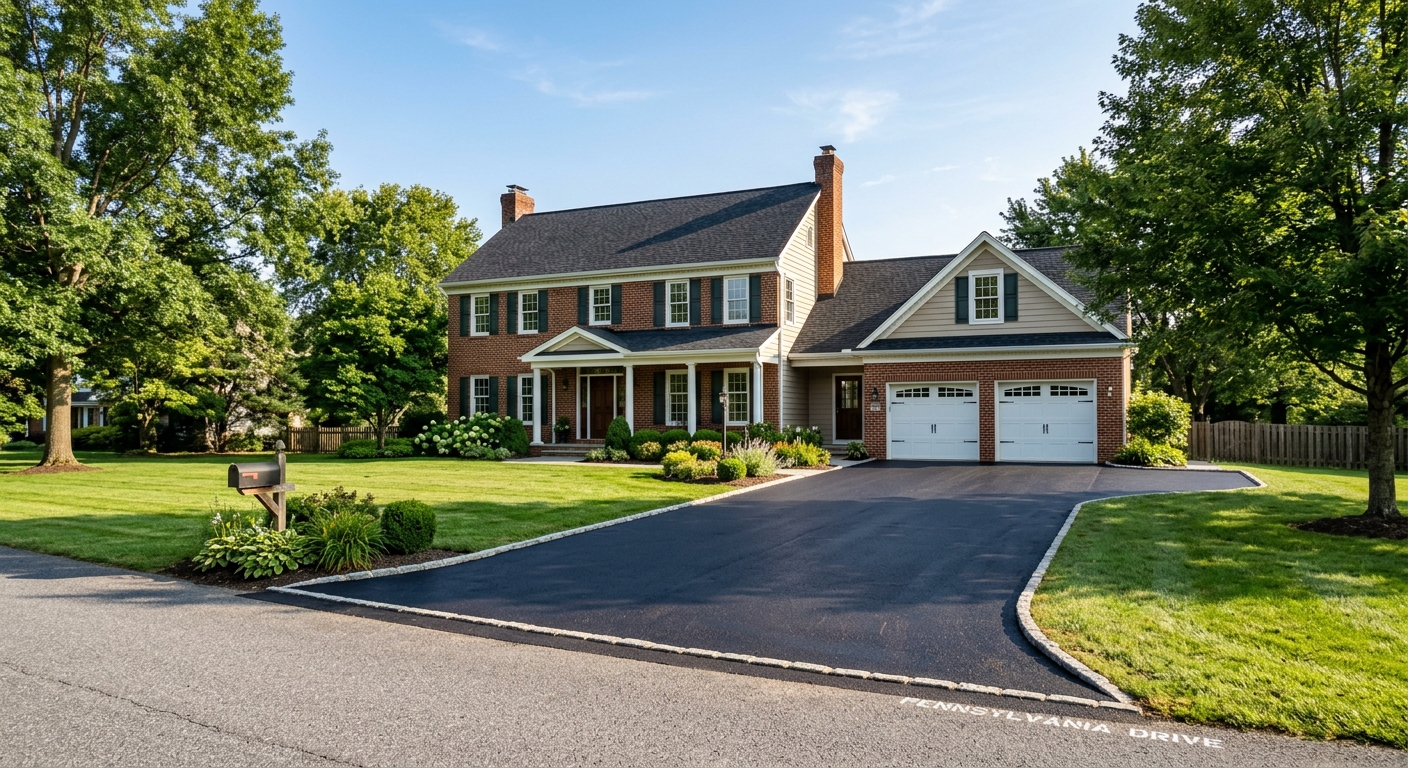
What a new driveway costs in Plainfield
In Plainfield, where over 80% of homes are single-family and homeownership is high (U.S. Census Bureau, ACS 2024), driveways are a major investment most households tackle at least once. With most local homes built before 1980, much of the driveways in the area are due for replacement rather than minor repairs. Our winters—marked by deep frosts and regular freeze-thaw cycles—are tough on pavement, and the Lehigh Valley limestone karst soil can mean settling or drainage problems if the base isn’t built right.
Here’s the truth that matters for your wallet: most of the real cost, or risk of hidden trouble, is in what you can’t see—base preparation, drainage, and subgrade work. Two jobs that look identical at the surface may have wildly different performance and lifespan based simply on whether the contractor addressed what’s under the blacktop or concrete. Driveways that are simply paved over a poor or settling base will fail fast in our climate, even if they look perfect the day they’re done.
| Service |
Best for |
Lifespan |
Price range |
| Asphalt — full replacement with new base |
failed base, structural cracking |
20–30 yrs |
$3,600–$9,200 |
| Asphalt overlay / resurfacing |
sound base, surface cracking only |
8–15 yrs |
$1,550–$4,600 |
| Sealcoating — single application |
preventive maintenance on sound asphalt |
2–4 yrs |
$200–$700 |
| Concrete — new installation |
long service life, low maintenance |
30–50 yrs |
$5,100–$12,500 |
| Crack filling and patching |
isolated cracks under a quarter inch |
1–3 yrs |
$200–$800 |
| Gravel driveway |
rural, budget, long runs |
5–10 yrs with upkeep |
$900–$3,500 |
Estimates for a typical Plainfield driveway. Square footage and base condition drive these figures more than material choice.
Diagnosing a failing Plainfield driveway
The first step for any Plainfield homeowner is getting a true read on the base beneath your driveway. Local contractors have every incentive to push for the expensive option—either a full replacement or a quick fix overlay—so you need to know what to look for before you get quotes.
Here’s what your driveway is telling you: If you see “alligator cracking”—those networks of cracks across a wide area—that’s a failed base. No amount of surface patching or overlay will last, since the sub-base can’t support the weight. Isolated, narrow cracks less than a quarter inch wide point to surface aging, which can be handled with crack filling and sealcoating. Depressions or “birdbaths” where water pools signal that the subgrade has moved or settled, often from drainage issues. Crumbling at the edges is classic for driveways with no proper edge restraint and will only worsen. A pothole means water has worked all the way through, usually via a crack, and you’ve got a compromised spot that needs full-depth repair.
Be wary: any contractor who quotes an overlay or patch without probing the base—either by core sample, digging a test hole, or similar—has not assessed your real problem. Money spent overlaying a failed base is money lost in this climate.
| What you see |
Likely cause |
Right fix |
Cost |
| Isolated cracks under 1/4 inch |
surface aging |
crack fill and seal |
$200–$700 |
| Alligator cracking over a wide area |
base failure |
full replacement |
$3,600–$9,200 |
| Depressions holding water |
subgrade movement |
excavate and rebuild that area |
$3,600–$5,600 |
| Crumbling edges |
no edge support |
edge repair, consider curbing |
$400–$1,500 |
| Potholes |
water into the base |
full-depth patch, then assess |
$250–$900 |
| Faded but sound surface |
oxidation only |
sealcoat |
$200–$700 |
How paving fraud actually operates
Driveway paving in a rural or semi-rural area like Plainfield is a common mark for scammers because jobs are highly visible, and most driveways don’t fail until years after the work is paid for. In a spread-out township, it’s harder to check a crew’s real background, and easier for them to disappear after cutting corners. Here’s how the cons work: you’ll be approached by someone claiming they have “leftover blacktop from a job down the road”—every legitimate paver buys materials per job, not on spec. Limited-time offers and today-only pricing are standard pressure tactics. Unmarked trucks with out-of-area plates are nearly always red flags. If a contractor insists on cash up front, or refuses to give you a written contract describing the exact scope and price, you’re at risk.
“Sealcoating” sold as a quick oil-based spray is another scam—true sealcoat uses proper latex or coal tar, applied at the right thickness. Watered-down or oil-sprayed driveways fade in months and do nothing to extend life.
Pennsylvania’s Home Improvement Consumer Protection Act requires a written contract for any job over $500, and gives you a three-business-day right to cancel. Never let anyone “waive your deductible”—it’s illegal here. These laws are made for exactly this scenario, so use them: never sign, never pay, and never let work start until you have a full written contract and have checked the HIC registration at hic.attorneygeneral.gov.
Protect yourself in five minutes: check their Home Improvement Contractor registration at hic.attorneygeneral.gov, verify workers’ comp on WCAIS (wcais.pa.gov), get a written contract, and never pay in full before work begins.
Why driveways behave differently in Plainfield
Plainfield sits on Lehigh Valley limestone karst—a geology that makes driveway construction here uniquely challenging. Limestone karst means underground voids and unpredictable settlement, so if a driveway isn’t built on a thick, compacted base with proper drainage, it can settle or crack within a few winters. This is especially true for driveways added to homes built before modern standards, and Plainfield’s housing stock is heavy with pre-1980 construction. Older driveways were often just blacktop atop dirt, with minimal sub-base. That’s why full replacement is so common here; you’re correcting decades of deferred infrastructure.
Combine that subgrade with a frost depth of 36 inches and severe freeze-thaw exposure—typical for northeastern Pennsylvania—and you get the perfect recipe for heaving and surface failure if water isn’t managed. Water that works its way through cracks or along drive edges will freeze, expand, and break up the material from below in winter, or disappear into voids, causing localized settling in spring.
Driveway longevity here isn’t just about the surface but how well the base handles that movement. In Plainfield and all of Northampton County, a well-built driveway starts with careful attention to the base, drainage, and the unique behavior of limestone soils—it’s not the same as the clay or shale of the next county over.
Which surface survives Plainfield winters
In Plainfield, winter is the main enemy of every driveway. With a 36-inch frost depth and 6,100 heating degree days, freeze-thaw cycling is relentless. Asphalt is the workhorse here because it flexes and shifts with the ground, handling these cycles by moving instead of cracking outright. Even with the limestone karst under us, a well-built asphalt drive—thick base, proper compaction, robust drainage—will outperform a poorly built concrete drive in service life and hassle.
Concrete has its attractions: it lasts longer on paper, and maintenance is low. But it’s also far more expensive to install, and in Plainfield, the real killer is spalling or flaking from de-icing salts. Road crews and homeowners here use salt every winter just to keep driveways passable, and even when you promise to avoid it, it’s hard to enforce for everyone in a household. That’s why so much concrete around here fails earlier than you’d expect.
Pavers are a solid premium option where budget allows, because damaged sections can be lifted and reset. Gravel is still used for long, rural driveways—especially on budgets or where impervious surface limits development.
| Option |
Installed cost |
Maintenance |
Freeze-thaw performance |
Lifespan |
| Asphalt — new install |
$3,600–$9,200 |
sealcoat every 3–4 yrs |
excellent, flexes |
20–30 yrs |
| Asphalt — overlay |
$1,550–$4,600 |
same |
good if base is sound |
+8–15 yrs |
| Concrete |
$5,100–$12,500 |
low, avoid de-icing salt |
fair, spalls with salt |
30–50 yrs |
| Pavers |
$8,200–$12,500 |
individual units replaceable |
good, settles gradually |
25–50 yrs |
| Gravel |
$900–$3,500 |
top-dress every 2–3 yrs |
excellent drainage |
indefinite with upkeep |
Changing the footprint of a Plainfield driveway
If you’re planning more than a like-for-like replacement—say, widening for a second car, adding a parking pad, or changing a gravel run to asphalt—there are a few specifics for Plainfield homeowners to know. Any change to the driveway’s footprint means starting from scratch over untouched ground, so the new base must be well-compacted and graded for decent drainage. Where old and new surfaces meet, expect that seam to be a permanent weak point; it needs careful base bonding and compaction to avoid later cracking or settling.
Widening or extension projects sometimes bump up against local zoning that restricts how much of your lot can be impervious, and almost always carry setback requirements to keep driveways away from property lines. If you’re working near the road, remember that a separate approach permit is usually needed: on state routes, that’s through PennDOT District 5-0, while township roads fall under your township’s code office.
Replacing gravel with asphalt is common in Plainfield, but transitioning more than just the surface means the right base for the heavier load and preventing water from running off onto your neighbor’s land, which can create liability even if you have permits. Plan on more excavation and cost than a simple resurface.
Permits and approvals for paving in Plainfield
If you’re resurfacing or patching an existing driveway in Plainfield and not expanding it, a permit is rarely needed—Palmer Township, for example, does not require permits for minor asphalt patching of residential driveways. However, expanding a driveway’s footprint, pouring new concrete, or installing a completely new driveway does often require building or zoning permit review, especially in nearby Bethlehem, where building and zoning rules kick in for new or expanded paved surfaces.
One area where many homeowners get caught is at the driveway approach—the section joining the street. Here, permitting authority depends on the type of road. On state-maintained routes, you need an approach permit from PennDOT District 5-0. For local township roads or curb cuts, your township handles the approvals. These permits ensure that drainage, sightlines, and public safety at street entrances are maintained.
Keep in mind: expanding driveways can trigger stormwater management requirements if the increase in impervious area exceeds local thresholds, and it is illegal (regardless of permit) to re-grade so that runoff is discharged directly onto a neighbor’s property. Hire only contractors registered as Pennsylvania Home Improvement Contractors (verify at hic.attorneygeneral.gov) and verify current workers’ compensation coverage with WCAIS (wcais.pa.gov) before you sign—these are consumer proof steps that protect you from liability and fraud.
Frequently asked questions — driveway paving in Plainfield
How much does it cost to widen a driveway?
In Plainfield, widening a driveway isn’t just about adding more asphalt or concrete—it means building up a new base, matching the grade and pitch to your existing surface, and tying into the old work so the seam doesn’t crack or settle. For a typical Plainfield driveway, expect widening to run in the same price band as new installation, since the most costly work is the excavation and base preparation. Asphalt typically comes in at $3,600–$9,200 for full-width jobs, with smaller extensions sometimes slightly less if the site is uncomplicated and access is easy. Costs can spike if there are drainage corrections or excavation over soft subgrade. Always check if an approach permit or zoning limits apply before you start work.
What is the difference between crack filling and sealcoating?
In Pennsylvania, especially with our freeze-thaw cycles in Plainfield, crack filling and sealcoating play different roles in driveway preservation. Crack filling is a targeted repair: rubberized filler is melted into individual cracks (typically under 1/4 inch wide) to keep water from reaching the base. Sealcoating, on the other hand, is a general surface treatment—a thin, protective layer applied across the whole driveway that protects against sun and chemical spills, and slows oxidation. In this area, a thorough crack fill and seal job usually runs $200–$700, and is a solid investment to prevent small problems from turning into major ones. Both prolong driveway life, but neither fixes major structural issues.
Is an overlay worth it or should I start over?
In Plainfield, an overlay (asphalt laid over your existing pavement) can add another 8 to 15 years if your base is solid and cracks are only at the surface. If there’s widespread “alligator” cracking, obvious dips, or potholes, overlays are usually a short-lived fix—water and frost will break through in a few seasons. The cost jump is clear: overlays run $1,550–$4,600 while full replacements are $3,600–$9,200. My advice: have the base checked by core sample or test pit before you overlay. If the base is failing, don’t overlay—it’s money burned in our conditions.
What causes concrete to spall or flake in Plainfield?
Concrete spalling and flaking in Plainfield is almost always linked to freeze-thaw cycles and use of salt-based de-icers. Our winters mean driveways go through many cycles of freezing and thawing, and concrete is rigid. When water and salt get into the surface, then freeze, the expansion pops and flakes off the top. Older concrete mixes or improper finishing make it worse. Even the best concrete in Northampton County—installed for $5,100–$12,500—will spall prematurely if salt is regularly used for ice. If you want long life, commit to non-chloride de-icers or sand, and always ensure your slab drains well so water isn’t trapped on the surface.
What does an asphalt overlay cost in Plainfield?
Asphalt overlays are a common fix in Plainfield if your current driveway base is still strong—meaning there’s no widespread cracking or settling. For most standard-size driveways here, with easy site access and no major repairs needed before the overlay, you can expect costs in the $1,550–$4,600 range. The lower end is for smaller or narrower driveways, and the upper for larger or more complex layouts. If your base is weak, an overlay might not last, so always have the subgrade checked before you decide.
How far ahead should I book a paver in Plainfield?
The paving season in Plainfield is dictated by weather—typically late April through October for best results, given cool soil temps and our freeze-thaw cycles. Reputable local contractors start booking spring slots as early as February. For a major job (full replacement or concrete), you’ll want to book 4-8 weeks out during peak season. Last-minute calls might miss the best window or force you into “fill-in” openings. For smaller jobs like sealcoating ($200–$700), contractors can usually fit you in quicker, but don’t count on same-week service in May, June, or September.
How many freeze-thaw cycles does Plainfield get?
Plainfield sits in the heart of northeastern Pennsylvania, where our climate produces dozens of freeze-thaw cycles each year—often 40 or more. That’s a major stressor for driveways, especially when water seeps into cracks and freezes, expanding and breaking the pavement from beneath. It’s why maintenance like crack filling ($200–$700) is especially important here. This level of cycling is tougher than in southern parts of the state, so everything from base depth to pitch should be designed accordingly.
How deep should the aggregate base be here?
The limestone karst beneath Plainfield demands a robust base to prevent settlement or heaving. For asphalt, a minimum of 6 inches of compacted aggregate is recommended—but on softer sections or larger driveways, 8 to 10 inches is common practice. Concrete driveways need a minimum of 4 inches of compacted base beneath a 4-inch slab. Skimping here is the fastest way to see heaves, settling, and early failure—especially since a full replacement is in the $3,600–$9,200 range, and the labor to do the base right is a small share of that cost. Always insist on proper compaction in lifts, never all at once.
Are there stormwater rules on paving in Plainfield?
Yes, in Plainfield and all of Northampton County, stormwater management comes into play if you’re expanding impervious surfaces such as a driveway. If your project pushes you past local thresholds, you may need to show how runoff will be managed to avoid flooding neighboring properties. Even if a permit isn’t required for a simple resurface, directing water onto a neighbor’s land can create liability. For a typical driveway expansion ($3,600–$9,200 for asphalt), always check with your township code office about current stormwater ordinances before starting. Drainage matters as much as material choice for driveways here.