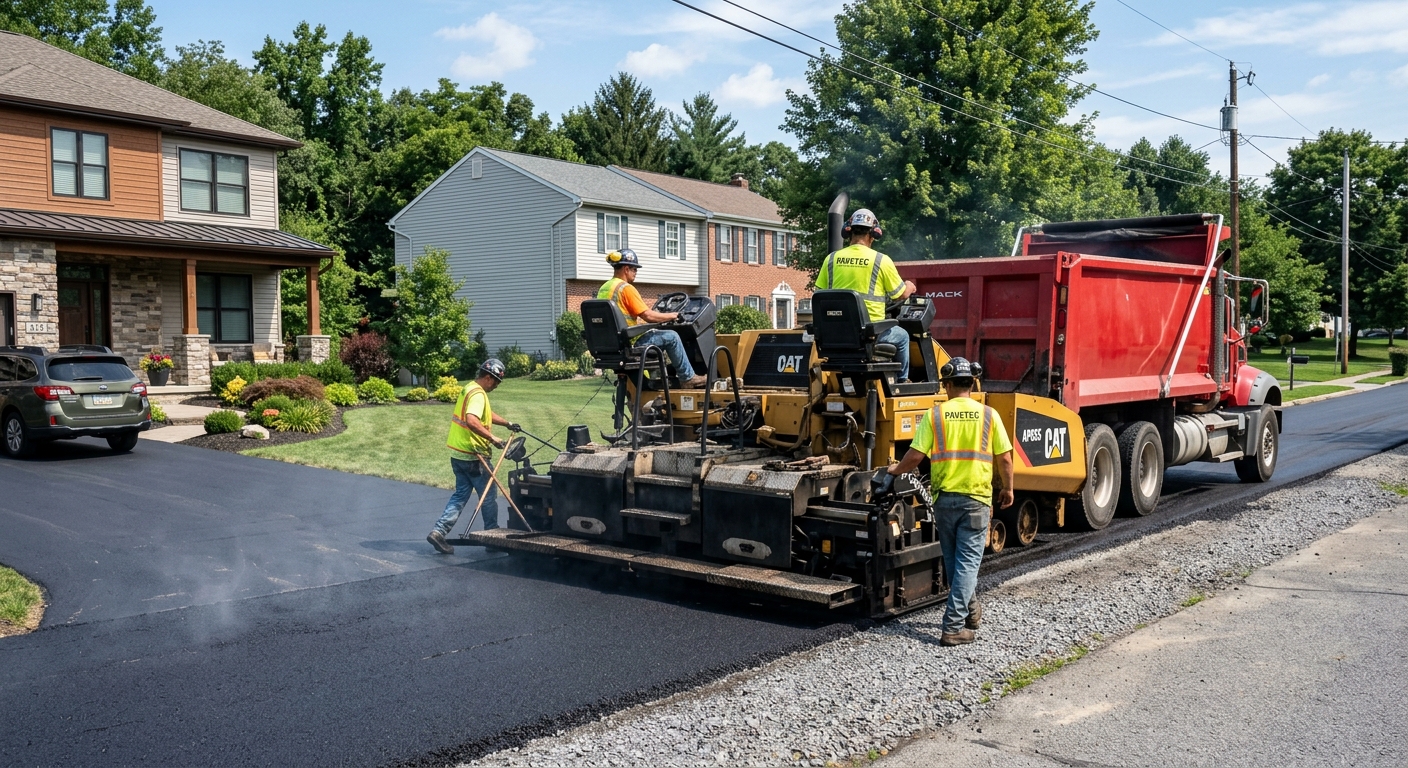
What a new driveway costs in Martic
In Martic, where over 85% of homes are single-family and the homeownership rate sits above 91% (U.S. Census Bureau, ACS 2024), driveway paving is one of the bigger maintenance expenses you’ll face. The market here is shaped by Lancaster County’s pronounced freeze-thaw cycles and moderate snowfall, both of which are hard on paving materials—and more importantly, on the stone and soil beneath. That means a quote for driveway work is mostly built below the surface. The visible paving is just the finish; what you can’t see is whether the contractor rebuilt the crushed stone base to a proper thickness, compacted it in manageable lifts, and fixed any drainage issues. Because of this, most of the price difference between two quotes for the “same” job will be buried, literally, under the surface. Cut-rate paving without a properly rebuilt base just won’t last in this climate. Saving a few hundred on the top layer usually means more repairs sooner.
| Service |
Best for |
Lifespan |
Price range |
| Asphalt — full replacement with new base |
failed base, structural cracking |
20–30 yrs |
$3,600–$9,200 |
| Asphalt overlay / resurfacing |
sound base, surface cracking only |
8–15 yrs |
$1,550–$4,600 |
| Sealcoating — single application |
preventive maintenance on sound asphalt |
2–4 yrs |
$200–$700 |
| Concrete — new installation |
long service life, low maintenance |
30–50 yrs |
$5,100–$12,500 |
| Crack filling and patching |
isolated cracks under a quarter inch |
1–3 yrs |
$200–$800 |
| Gravel driveway |
rural, budget, long runs |
5–10 yrs with upkeep |
$900–$3,500 |
Estimates for a typical Martic driveway. Square footage and base condition drive these figures more than material choice.
Which surface survives Martic winters
Martic gets real winters—pronounced freeze-thaw cycling, days below 12 °F, and persistent moisture. That shapes what lasts under your tires. Asphalt is flexible, which means it can move with the ground as it freezes and thaws. When the base heaves a touch in January, asphalt bends a bit and stays intact. That’s why most driveways here are blacktop. Concrete, on the other hand, is rigid. It will rune for decades if left undisturbed, but Pennsylvania’s winters and our use of de-icing salts are tough on it. Salt is the silent killer: it causes spalling and scaling, the sort of surface breakdown you’ll see in concrete after a few bad winters. Avoiding salt adds a behavioral catch—not everyone will remember, and if you forget, the repair cost is high. Concrete wins on lifespan if you’re meticulous, but that “if” matters.
Pavers and gravel both have limited but local uses. Pavers drain well, settle gently, and can be repaired in pieces; they're a premium option near historic properties. Gravel is by far the most forgiving on cost and handles freeze-thaw as well as anything, but expect regular regrading and top-dressing for a decent look.
| Option |
Installed cost |
Maintenance |
Freeze-thaw performance |
Lifespan |
| Asphalt — new install |
$3,600–$9,200 |
sealcoat every 3–4 yrs |
excellent, flexes |
20–30 yrs |
| Asphalt — overlay |
$1,550–$4,600 |
same |
good if base is sound |
+8–15 yrs |
| Concrete |
$5,100–$12,500 |
low, avoid de-icing salt |
fair, spalls with salt |
30–50 yrs |
| Pavers |
$8,200–$12,500 |
individual units replaceable |
good, settles gradually |
25–50 yrs |
| Gravel |
$900–$3,500 |
top-dress every 2–3 yrs |
excellent drainage |
indefinite with upkeep |
Permits and approvals for paving in Martic
In most of Martic and Lancaster County’s townships, you typically do not need a building permit just to resurface or replace an asphalt driveway in its current footprint. This saves you time and paperwork if you’re not changing the layout or connecting to public property. However, where your driveway meets the public road—the approach or apron—a permit is usually required. In Lancaster city, for example, these are handled by the City of Lancaster Bureau of Engineering, and for state routes, you’d go through PennDOT District 8-0. Even if you’re in Martic and not dealing with public streets, widening or changing the connection to any roadway generally triggers permitting.
Stormwater is its own concern. Expanding your driveway by adding width or paving what was once gravel can create runoff that affects your property or your neighbor’s. Even if a township doesn’t ask for stormwater review, Pennsylvania homeowners are liable for damage caused by water they redirect. When hiring a contractor, always verify their Home Improvement Contractor (HIC) registration through the Pennsylvania Office of Attorney General’s site (hic.attorneygeneral.gov), and confirm workers’ compensation coverage using WCAIS (wcais.pa.gov) if a crew is involved. Written contracts are required by state law for jobs over $500, with a mandated three-day right of cancellation to protect you.
What a real paving quote contains
A trustworthy driveway quote in Martic itemizes the details most homeowners never see: total measured square footage, proper excavation and haul-off, base material and its depth in inches, and how each layer (stone and asphalt) will be compacted. It spells out the thickness and type of asphalt “courses”—usually a binder (base) layer and a surface (wear) layer, each named and measured. It covers edge treatment (to prevent raveling), proper grading for drainage, and full job cleanup, including restoring lawn edges. Look for a payment schedule that asks for a modest deposit, then balance only after satisfactory completion. Last, see what the warranty actually covers—most exclude cracks outright, even though that’s the first thing to show up with poor prep or drainage.
A quote that’s just a single line—“Driveway paving, $X”—and nothing else, cannot be compared to a detailed bid. This is the most common way folks end up paying full price for work that doesn’t last through three Martic winters. Take the time to read line by line.
| Line item |
What to look for |
Red flag if… |
| Area |
measured square footage stated |
eyeballed or absent |
| Excavation |
depth and disposal included |
'we'll pave over it' |
| Base |
aggregate type and depth in inches |
'proper base' |
| Compaction |
method, and done in lifts |
not mentioned |
| Asphalt |
courses and compacted depth |
'3 inches' unqualified |
| Drainage |
slope and water direction stated |
silent |
| Warranty |
what is covered and what is excluded |
verbal only |
| Payment |
modest deposit, balance on completion |
full cash up front |
Where the water goes
Water is enemy number one for every driveway in Martic. The job isn’t done with the last pass of the roller; it’s done when water runs where you want it—not into the base, under the slab, or toward the garage. For surface runoff, minimum slope is key: even a 1/8 inch per foot cross-slope will keep water moving. Most driveways here use a gentle cross-slope or are crowned to shed water. If your drive slopes toward any structure, you’re at risk for ponding by the foundation; this is when trench or channel drains come into play, directing water away if the grade can’t be altered.
Because Lancaster County sees pronounced freeze-thaw cycling, any water that seeps into the driveway base will freeze and expand, heaving the pavement and leaving behind cracks and dips. If the soil is heavier clay—common in parts of the area—drainage becomes even more critical, as clay holds water against the base longer. Piping water to “daylight” (an open slope), or to a dry well, are standard solutions. But always remember: you cannot discharge stormwater onto your neighbor’s land, no matter what the permit says. Liability follows the water, not the paper trail.
Changing the footprint of a Martic driveway
If you want to widen your driveway for a second vehicle, add a turnaround for easier entry/exit onto country roads, or extend pavement out to a detached garage or barn, the work is fundamentally different than resurfacing. Any new area means building the base from scratch over undisturbed ground, not just over old stone. The connection between new and old is always going to be the weakest point—if a seam is necessary, it needs careful compaction and sometimes a fabric joint to minimize future cracking.
Additions often trigger local limits on impervious surface—rules that keep homeowners from covering their entire lot and overwhelming storm drains—plus setback requirements for how close you can pave to property lines. In the Martic and surrounding townships, you likely won’t need a permit just for resurfacing, but if you’re moving or enlarging the approach to the road, that’s a separate permit handled by either the City of Lancaster Bureau of Engineering or PennDOT District 8-0 (if it’s a state road), as outlined in local rules. Plan stormwater carefully, and ask your contractor to specify exactly how water will be kept away from both your own and your neighbor's property.
The honest case for and against sealcoating
Sealcoating is often pitched as a cure-all for driveways in Martic, but that’s not exactly the case. What sealcoating truly does is provide a sacrificial layer that protects the asphalt’s binder from UV rays, air, water, and slow chemical attack from fuel and oil. It can also restore a uniformly black look, helping a worn driveway appear fresh again. But it does not add any real structural strength, nor will it fix cracks or bring a failing base back to life. If your driveway is already alligator-cracked or rutted, sealing just buys a year or two of appearance.
The untold downside: too-frequent sealing leads to buildup that will eventually crack and peel, especially in Martic’s freeze-thaw cycles. Fresh asphalt needs six months to a year to cure before it should be sealed; applying sooner locks in volatiles and makes peeling all but certain. A reasonable interval for a healthy drive is every 3–4 years, not annually. Ignore anyone who says otherwise.
Crack filling actually matters more in terms of longevity. Proper hot-applied crack fillers keep water out of the base, which is the single best thing you can do for a Martic drive. A cheap spray-and-go sealcoat doesn’t last: the true price for one solid application is $200–$700. If you’re quoted far less, you’re likely getting diluted product or a job that barely covers the surface.
Frequently asked questions — driveway paving in Martic
What are the signs of a failing driveway base?
If you see large, interconnected “alligator” cracks, depressions where water pools, or patches of heaving or rutting that don’t follow a seam or single crack line, it’s usually the base that’s failed—not just the surface. In Martic’s freeze-thaw climate, what begins as small cracks can quickly become deep dips after winter. When water penetrates the top course and freezes, it expands and destroys the base stone below, leading to further breakdown. Once this cycle begins, patching is temporary. At this stage, the best fix is a full-depth replacement, which in Martic runs between $3,600–$9,200 for most single-family homes.
What is the difference between binder and surface course?
In a typical Martic asphalt driveway, the binder course is the thicker, coarser layer laid first over the stone base. It provides strength and builds the body of the driveway. The surface course—often called the “top” or “wear” course—is finer and placed above the binder. It creates a smooth, weather-resistant finish. The binder handles the structural loads, including freeze-thaw heaving and settlement, while the surface protects against water, sunlight, and abrasion. Quotes should always specify compacted depth for both; skipping the binder or skimping on its thickness is a common way poor contractors undercut bids. Properly built, this two-layer system is included in the price band of $3,600–$9,200.
Are door-to-door pavers a problem in Martic?
Yes, door-to-door pavers show up in Martic every season—especially after major storms or in spring. These crews offer “surplus asphalt” at what seem like deep discounts, but almost always cut corners on prep and skip written contracts, both of which Pennsylvania’s Home Improvement Consumer Protection Act requires for jobs over $500. Work done without a real base, proper compaction, or itemized quote almost never holds up to our region's freeze-thaw cycles. Homeowners wind up paying again for a real fix. Always verify registration at hic.attorneygeneral.gov and expect a price in the market range of $3,600–$9,200 for a true full-depth job—not a rush job with leftovers.
How long does a driveway installation take?
In Martic, a full replacement asphalt driveway for a typical single-family home usually takes two to four days start to finish, depending on weather and square footage. The timeline includes excavation, installing the new base, compacting each layer, and paving the asphalt. Add a day or two for concrete, as it requires extra curing time before driving on it. Overlay projects can sometimes be done in a day, but only if the base is sound. Regardless, prices like $3,600–$9,200 for asphalt or $5,100–$12,500 for concrete reflect not just materials, but labor and the steps needed for our climate.
When can I seal a brand new asphalt driveway?
Patience is key in Martic’s climate. Fresh asphalt needs a full curing period—typically six months to a year—before applying any sealer. Sealing too soon traps oils and solvents under the surface, which leads to peeling and a shorter lifespan. Plan to seal your new drive in the following summer or fall, never sooner. A proper sealcoating job every 3–4 years afterward, at a price of $200–$700 per application, will keep the surface protected and looking sharp, but don’t rush that initial coat.
How much does it cost to widen a driveway?
Widening a driveway in Martic means building new base and paving along the edge. Costs depend on square footage and access, but adding a 3–5 foot width for typical passenger vehicles generally ranges from $1,550–$4,600 (overlay) up to $3,600–$9,200 (full-depth asphalt). If concrete is chosen, use the $5,100–$12,500 band. Always confirm that local township setback and impervious surface rules allow for the change, especially if adding a new approach to the road, as permits may apply.
Is an overlay worth it or should I start over?
In Martic, overlays make sense when the base is solid: no deep cracks, no soft spots, and no drainage issues. Overlays cost less—typically $1,550–$4,600—and buy you 8 to 15 years of life. But if there’s any structural base damage, an overlay only covers and delays a real fix. The thin new layer will follow every dip and crack as freeze-thaw cycles work. If in doubt, get a core test or have the area saw-cut to check the base. If base failure is present, skip the overlay and invest in a full rebuild; it costs more up front, but saves repairs within a few years.
Do I need a permit to repave a driveway in Martic?
For most Martic township properties, repaving an existing private asphalt driveway in the same size and location does not require a permit, which removes some cost and nuisance for homeowners. However, if you’re modifying the driveway’s approach—where it meets a public road—or working near a state highway, expect to file with the City of Lancaster Bureau of Engineering or PennDOT District 8-0, as highlighted by county rules. No permit is needed for basic resurfacing, but any change in footprint or expansion will likely trigger review. Keep this in mind, as costs for most driveways will still be within $3,600–$9,200.
What does sealcoating cost in Martic?
For a typical Martic single-family driveway, expect a true professional sealcoating application to run between $200–$700 per treatment. The lower end covers smaller drives or group rates with neighbors; the higher end is for wide or long entries. Be wary of quotes far below this range—those often mean corners are being cut with watered-down products. Sealcoating every three to four years, not annually, is standard here to balance protection and cost. Spend wisely: the service works when done right, but won’t solve deep cracks or bring back a failed base.