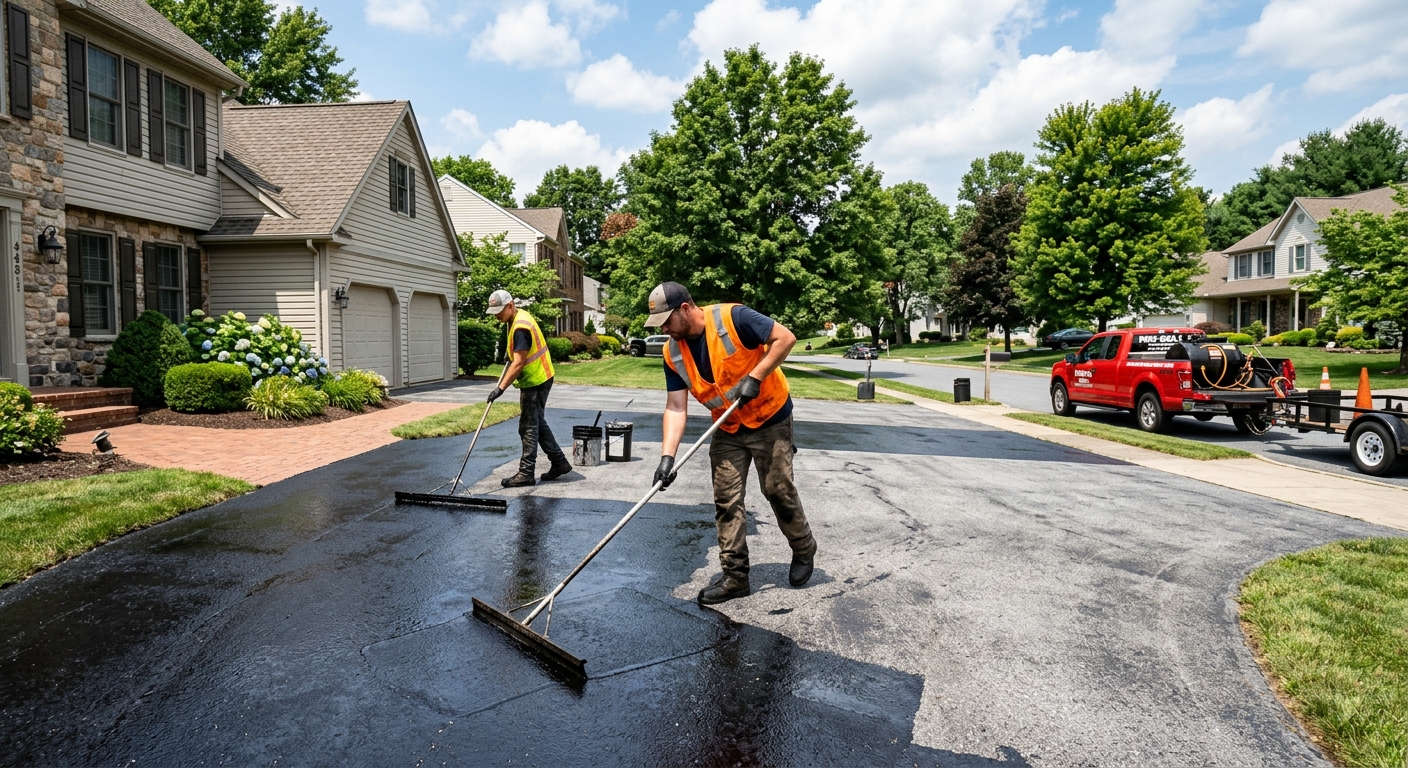
What a new driveway costs in Providence
Most Providence homeowners own a single-family property—more than half in fact (57.8%), with a high homeownership rate of 82.3% (U.S. Census Bureau, ACS 2024). That means a driveway upgrade is a common, necessary investment here, not just a cosmetic project. Providence’s location in Lancaster County brings pronounced freeze-thaw cycles and moderate snowfall, which wear down both asphalt and concrete over time. But beneath your feet, it’s the unseen soil work that governs most of what you’ll eventually pay. In nearby East Hempfield Township, limestone karst soils require extra-thick aggregate bases; that may influence your job’s cost and approach if similar soils continue under your lot.
No matter what surface you pick, it’s what happens under the pavement—excavation, base depth, drainage—that drives most of the cost and longevity. Two quotes that look alike on paper can differ by thousands of dollars—and 10 years of driveway life—strictly because of decisions and shortcuts you’ll never see. That’s why the range per job is so wide in Providence, even for similarly sized driveways and the same visible top layer.
| Service |
Best for |
Lifespan |
Price range |
| Asphalt — full replacement with new base |
failed base, structural cracking |
20–30 yrs |
$3,500–$9,100 |
| Asphalt overlay / resurfacing |
sound base, surface cracking only |
8–15 yrs |
$1,500–$4,500 |
| Sealcoating — single application |
preventive maintenance on sound asphalt |
2–4 yrs |
$200–$700 |
| Concrete — new installation |
long service life, low maintenance |
30–50 yrs |
$5,000–$12,000 |
| Crack filling and patching |
isolated cracks under a quarter inch |
1–3 yrs |
$200–$800 |
| Gravel driveway |
rural, budget, long runs |
5–10 yrs with upkeep |
$900–$3,500 |
Estimates for a typical Providence driveway. Square footage and base condition drive these figures more than material choice.
Asphalt or concrete for a Providence driveway?
Providence and the rest of Lancaster County get hit hard by freeze-thaw cycles: cold snaps, thaws, moisture, and then another freeze. In this climate, the flexibility of asphalt is a major advantage. Asphalt driveways flex as the ground moves, taking up the seasonal buckling caused by the region’s freeze-thaw conditions without the brittle cracking seen in old concrete. That’s why asphalt is the default here, especially for straight-wheel runs and driveways where winter plows, snowblowers, and de-icers are a fact of life.
Concrete will last much longer if untreated, but Lancaster County’s moderate snowfall means you can’t avoid de-icing salt unless you’re disciplined. Salt mixed with freeze-thaw chews up concrete—spalling, scaling, and cracking are common. There’s no sense in paying for a 50-year slab if a few bad winters will destroy the finish in under 15. You can certainly choose concrete for a low-maintenance, long-life surface, but only if you’re ready to never use salt-based melt products and to keep the slab cleared. Most folks here end up re-doing bad concrete after a decade and wish they’d gone asphalt.
Pavers or stone can work for turnarounds or old-lot aprons (common in Lancaster city’s pre-1940 stock), providing excellent drainage and easier repair—at a higher cost. Gravel is still a real option for long, rural runs or budget projects, needing more maintenance but lasting indefinitely with care.
| Option |
Installed cost |
Maintenance |
Freeze-thaw performance |
Lifespan |
| Asphalt — new install |
$3,500–$9,100 |
sealcoat every 3–4 yrs |
excellent, flexes |
20–30 yrs |
| Asphalt — overlay |
$1,500–$4,500 |
same |
good if base is sound |
+8–15 yrs |
| Concrete |
$5,000–$12,000 |
low, avoid de-icing salt |
fair, spalls with salt |
30–50 yrs |
| Pavers |
$8,100–$12,000 |
individual units replaceable |
good, settles gradually |
25–50 yrs |
| Gravel |
$900–$3,500 |
top-dress every 2–3 yrs |
excellent drainage |
indefinite with upkeep |
Comparing paving estimates in Providence
Most of what you pay for in a driveway installation in Providence is buried—literally—under the top layer. When you compare quotes, focus on the nuts and bolts: total measured square footage, how deep the old drive will be excavated (and if disposal’s included), how thick the base will be rebuilt, and what materials are specified. Local limestone aggregate is best under Providence driveways, especially where soils require better drainage, so make sure the quote names both thickness (in inches) and the specific base type.
Each course of asphalt should list compacted thickness, not loose. Edge treatments matter—if edges aren’t supported or detailed, they’ll fail early. Water should be graded away from the house and off to storm drains, not toward you or your neighbor. Look for restoration of lawn edges after excavation, a realistic warranty (usually 1 year, and almost never covers cracking), and a payment schedule with a reasonable deposit and most money at the job’s end. If a quote just names a total—no measurements, no base specs—it can’t be compared and shouldn’t be trusted. That’s the number one way Providence homeowners end up overpaying.
| Line item |
What to look for |
Red flag if… |
| Area |
measured square footage stated |
eyeballed or absent |
| Excavation |
depth and disposal included |
'we’ll pave over it' |
| Base |
aggregate type and depth in inches |
'proper base' |
| Compaction |
method, and done in lifts |
not mentioned |
| Asphalt |
courses and compacted depth |
'3 inches' unqualified |
| Drainage |
slope and water direction stated |
silent |
| Warranty |
what is covered and what is excluded |
verbal only |
| Payment |
modest deposit, balance on completion |
full cash up front |
Widening, extending or adding a parking pad
Providence homeowners often find themselves needing more room than their original driveways allowed—especially in older developments with narrow, shared aprons or when adding a detached garage or turnaround. Anytime you widen, extend, or add a parking pad, you’re dealing with new base over undisturbed earth, not just a surface fix. That new work sits next to your existing drive, and the seam between old and new will always be weaker—expect a hairline crack or shift over time no matter how skilled the installer. If you’re paving right up to a property line, set-back rules kick in; don’t expect to pave to the edge without checking local zoning.
Adding or modifying driveway footprints in Providence can also trigger stormwater management rules because new paved surfaces increase impervious area. While a typical resurfacing in most Lancaster County townships won’t require a right-of-way permit, any change where your driveway meets the public street—a new approach or curb cut—does require a permit from the Bureau of Engineering in Lancaster city or PennDOT for state routes. Keep expansion projects legal by asking for all permits up front, and don’t let a contractor skip these details to save time. If you replace a rural gravel drive with asphalt or concrete, expect a higher build cost for proper base prep and careful drainage—especially over local karst soils.
Overlay, patch or full replacement?
With driveways in Providence, the difference between a patch, an overlay, and a full replacement comes down to what’s underneath. Any contractor can make a tired drive look “new” for a season, but you only get value if the base and subgrade are still stable. Here’s how to spot the difference:
“Alligator” or spiderweb cracking in wide areas means the base failed already—no surface overlay will fix it for long. Linear cracks, less than a quarter inch wide, can usually be cleaned, filled, and sealed. Birdbaths or standing water mean subgrade movement or improper grading; patching over won’t prevent them from returning. Crumbling at the edges suggests the drive was laid thinner at the edge or lacked support—these can sometimes be stabilized but often mean other corners were cut. Potholes mean water already reached the base, and those areas need to be patched full-depth, then the rest assessed.
If a contractor quotes a resurfacing without checking what’s below—digging test pits or probing at the edge—they haven’t diagnosed the problem and you’re likely wasting money. An overlay over a failed base is a short-term bandage. Trust only quotes where the contractor justifies their recommendation with what’s really under your current drive.
| What you see |
Likely cause |
Right fix |
Cost |
| Isolated cracks under 1/4 inch |
surface aging |
crack fill and seal |
$200–$700 |
| Alligator cracking over a wide area |
base failure |
full replacement |
$3,500–$9,100 |
| Depressions holding water |
subgrade movement |
excavate and rebuild that area |
$3,500–$5,500 |
| Crumbling edges |
no edge support |
edge repair, consider curbing |
$400–$1,500 |
| Potholes |
water into the base |
full-depth patch, then assess |
$250–$900 |
| Faded but sound surface |
oxidation only |
sealcoat |
$200–$700 |
How to vet a paving contractor in Providence
Hiring the right paving contractor in Providence means more than checking a website. You need a registered, insured, locally grounded business with a proven record—not just someone with a truck and a phone number. Pennsylvania requires Home Improvement Contractor (HIC) registration for jobs over $500; you can verify this at hic.attorneygeneral.gov. For any employee crews, workers' compensation is mandatory—verify current coverage on WCAIS (wcais.pa.gov). Real contractors will have a physical office or yard address, not just a P.O. Box or mobile, and use their own equipment instead of renting everything. Ask for references from customers whose driveways are four or more seasons old—fresh jobs don’t prove anything about longevity. Most importantly, a legitimate local paver will know exactly which Lancaster County asphalt plant they buy from. Our aggregate and asphalt supply is specific: local limestone and regional plants near Lancaster serve most of Providence. If a contractor is hazy or evasive about these basics, move on.
- HIC registration current and verifiable at hic.attorneygeneral.gov
- Workers’ compensation verified through WCAIS
- Physical business address in Lancaster County
- Owned equipment (not all rented)
- References from jobs 3–5 years old
- Specific knowledge of local asphalt plants and quarries
- Detailed written contract over $500 (per state law)
- Deposit terms reasonable (no full cash up front)
- Written warranty explains what is and isn’t covered
- Insurance certificates provided up front
- Proof of past permitting in Providence or Lancaster County
- Clear, specific estimate for excavation, base, materials, and cleanup
If any of these boxes go unchecked—especially registration, insurance, equipment ownership, or a physical address—someone is gambling with your money, your property and possibly your liability.
What you need before paving in Providence
For most Providence homeowners, replacing or resurfacing an existing private asphalt driveway proceeds without a building or right-of-way permit if you stay within the original footprint (according to Lancaster County township rules). But as soon as your project affects where the driveway meets the public street—like a new approach, apron or curb cut—a separate permit is needed through the City of Lancaster Bureau of Engineering, or PennDOT District 8-0 if you’re on a state route. The authorities here are not always the ones homeowners expect, so check the jurisdiction before work starts to avoid issues that can lead to fines or unnecessary rework.
If you expand your drive, paving more impervious surface, that can trigger stormwater management requirements—there’s a limit on how much runoff you can put into the street or your neighbor’s yard. Codes aside, Pennsylvania liability attaches if water shed from your new paving damages a neighbor’s foundation or landscaping, so always slope and drain correctly.
Your contractor must be HIC registered (hic.attorneygeneral.gov) for any job over $500, and provide proof of workers’ compensation through WCAIS. The contract itself must be written and detail your right to cancel, as required under state law. If your Providence home predates 1978 and any painted surfaces will be disturbed (for example during curb or apron work), the federal Lead RRP Rule applies, and certification must be shown.
Frequently asked questions — driveway paving in Providence
Can asphalt be laid in cold weather?
Asphalt paving is temperature-sensitive, and in Providence and broader Lancaster County, cold weather sets a real limit. Asphalt needs to remain workable for compaction, which is tough below about 45°F ground temperature. If the air is colder than 40°F, or the base is frozen, asphalt won’t bond or compact right—and will fail early. Most professional jobs happen from April through late October. Off-season installs might save a buck but usually cost you in lifespan and repairs. If a contractor offers midwinter paving, be wary: your installation won’t last the typical $3,500–$9,100 term you paid for.
Do I need an approach permit where my driveway meets the road?
In Providence, the “approach” is where your private drive meets the public street. While township rules let you resurface or replace a drive on your own property without a permit, making changes at the road—aprons, widening, or new curb cuts—does require a permit, and it’s not always the township who issues it. In Lancaster city, it’s the Bureau of Engineering; for state routes, you deal with PennDOT District 8-0. Skipping this step can get your project shut down or even lead to fines, so always check first. Most regular driveway resurfacing projects (in the $1,500–$4,500 range) avoid this but anything involving the street must be permitted.
What is the difference between crack filling and sealcoating?
Both crack filling and sealcoating are vital maintenance tasks, but they serve different purposes on Providence driveways. Crack filling addresses specific linear cracks—usually under a quarter inch—using a hot or cold pourable material to keep water out of the base. Sealcoating, on the other hand, is a surface treatment: a thin, protective layer applied over the whole asphalt drive to shield it from UV and water damage and keep the surface looking fresh. Filling cracks and then sealcoating is the right order. Expect crack filling to run about $200–$800, while a full sealcoat is typically $200–$700 per cycle.
How deep should the aggregate base be here?
In Providence, the aggregate base is the foundation of any paved driveway. For asphalt, 4 to 8 inches of compacted limestone base is standard, but in areas with the limestone karst soils common in neighboring East Hempfield, you may need to go thicker (sometimes up to 12 inches) for proper support and drainage. Thinner bases are sometimes used to cut costs, but they lead to premature cracking and surface depression, especially in our climate. A good base is what distinguishes a $3,500–$9,100 long-life installation from the ones that fail after a few freezes.
Why are paving quotes in Providence so different from each other?
Quote differences in Providence aren’t just about profit—they reflect real differences, often invisible to the homeowner. Some contractors cut corners by skipping on base thickness, using cheaper aggregate, skimping on compaction, or ignoring proper grading and drainage. The lowest bid sometimes comes from skipping a critical step underground that shortens your driveway’s life by years. Meanwhile, another contractor may be giving you a full-depth rebuild priced at $3,500–$9,100 while the other is just slapping on a thin overlay. Always compare line-by-line: if a quote isn’t specific about removal, base prep, material depth, and precise area, assume corners are being cut.
Are pavers worth the cost in south-central Pennsylvania?
Pavers are a premium option for Providence homeowners who want something distinctive and are willing to invest up front. While the installed cost—$8,100–$12,000 for a typical drive—is higher than asphalt or even regular concrete, maintenance is more flexible: individual blocks can be replaced if they settle or crack, and pavers allow excellent drainage, reducing freeze-thaw issues. They’re especially useful for short drives, old-lot aprons, or areas needing complex shapes. But expect regular joint refilling and the potential for weed growth if not maintained.
How much does it cost to widen a driveway?
Widening a driveway in Providence is more than just extra surface—it usually means new excavation, base construction, and matching to the old drive. The cost depends on how much new width is added and total length, but a small widening (a few feet full-length) might range from $2,000–$5,500. Larger extensions or a new parking pad can cost more. All new pavement must meet the same standards as a full installation, not just a surface patch. Don’t forget permitting—new approaches or work in the right-of-way will require paperwork with the Bureau of Engineering or PennDOT if you hit a state route.
What kind of soil is under Providence driveways?
In Providence and much of Lancaster County, driveways generally sit over limestone-based soils, especially karst formations west toward East Hempfield. This means pockets of soft spots, sinkhole risk, and poor drainage unless aggregate bases are done correctly and thick enough. These soils demand more thoughtful base construction than elsewhere; shortcuts under Providence driveways are often exposed after just a couple hard winters. That’s why the thicker base needed here—up to 12 inches in some areas—affects the cost, pushing some jobs higher in the $3,500–$9,100 range even for average-size properties.
What are the signs of a failing driveway base?
Failing driveway bases in Providence show up as alligator (network) cracking across wide sections, depressions (birdbaths) that collect water, continuing pothole formation, and crumbling edges. Sometimes, the surface looks rougher every year even after sealcoating, or there are sudden vertical shifts where the drive meets the apron. These signs mean the problem starts underneath—the real fix is excavation and rebuild, not just an overlay. Expect full replacement to land in the $3,500–$9,100 price bracket for most jobs. Surface cracks, on the other hand, usually signal aging but not base failure, and can be filled and sealed for a much lower cost.