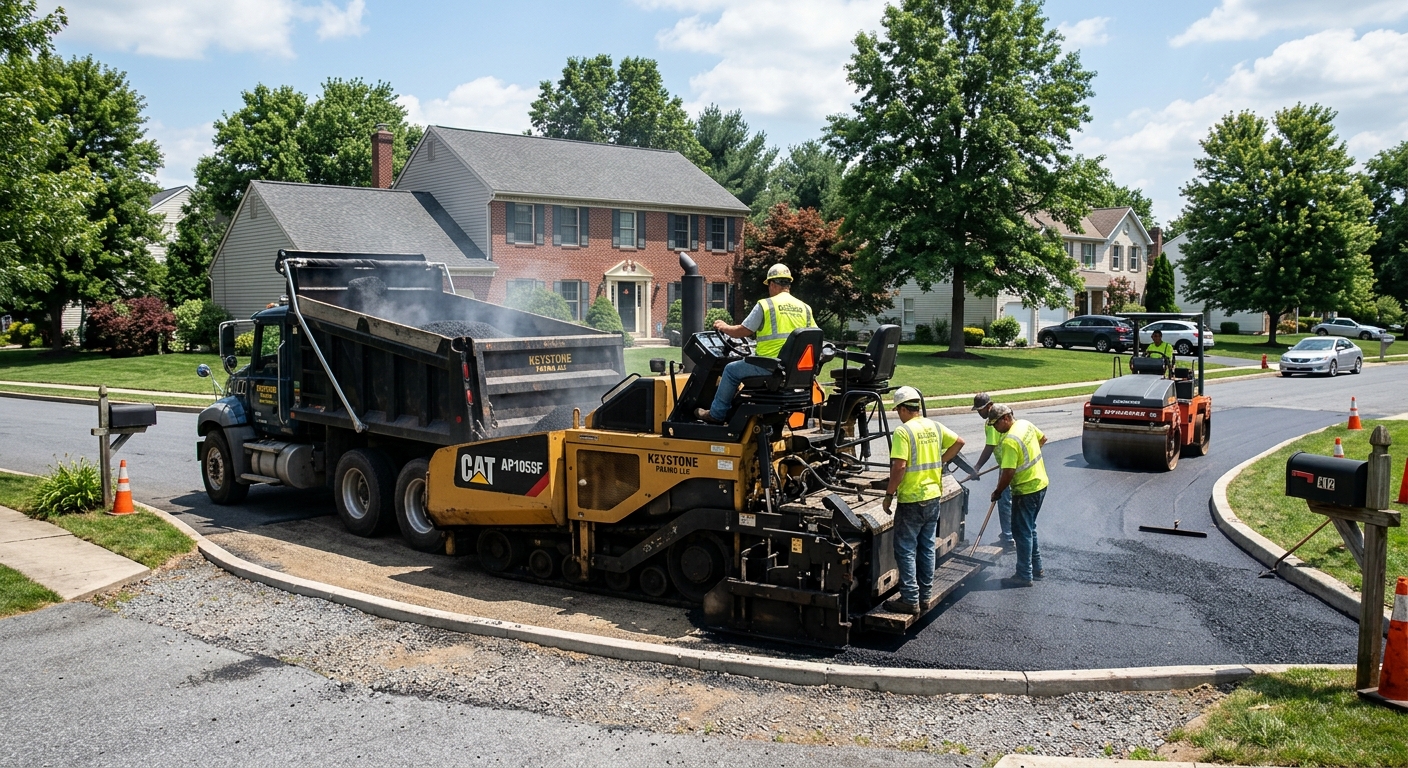
Hanover paving prices by scope — 2026
Across Hanover’s neighborhoods, most single-family homes (63.3%) sit on their own small lots (U.S. Census Bureau, ACS 2024), and with nearly 68% of households owning their property, driveway work rests squarely on local shoulders—not on landlords. In Luzerne County, the freeze-thaw cycle is no small matter: when asphalt or concrete cracks, water from winter storms seeps below. The glacial till and shale subgrade found across Hanover and nearby towns mean local contractors must build thicker, more stable stone bases than driveways you’d see further south.
That’s why most of the price difference between two paving quotes is hidden from view. What you’ll see—a shiny new surface—matters less than what lies beneath. Whether you’re budgeting for a full dig-out and replacement or a quick resurfacing, understand that topcoat alone never fixes a weak base. Paving in Hanover is a long-term expense; a lowball bid often trims corners underground. If you want it to last through years of 4°F winter nights and 40-inch frost depths, you need to shop for the right build, not just the lowest number.
| Service |
Best for |
Lifespan |
Price range |
| Asphalt — full replacement with new base |
failed base, structural cracking |
20–30 yrs |
$3,300–$8,600 |
| Asphalt overlay / resurfacing |
sound base, surface cracking only |
8–15 yrs |
$1,450–$4,300 |
| Sealcoating — single application |
preventive maintenance on sound asphalt |
2–4 yrs |
$200–$650 |
| Concrete — new installation |
long service life, low maintenance |
30–50 yrs |
$4,800–$11,500 |
| Crack filling and patching |
isolated cracks under a quarter inch |
1–3 yrs |
$200–$800 |
| Gravel driveway |
rural, budget, long runs |
5–10 yrs with upkeep |
$900–$3,500 |
Estimates for a typical Hanover driveway. Square footage and base condition drive these figures more than material choice.
Numbers, not adjectives
Want your Hanover driveway to survive more than a few winters? Start caring less about “best price” and more about written specs. In Luzerne County’s climate—where winter lows dip to 4°F and the ground freezes down three feet—a vague promise of “three inches of asphalt” means nothing. “Three inches” as loose-laid hot mix compacts down, often to less than two. In the hands of a good crew, it’s measured as finished, not as spread.
Area contractors who know the glacial till and shale subsoils here will specify a thicker aggregate base and be up front about each layer’s compaction. Paving can only be as strong as its weakest tier. Don’t let anyone talk you into a shortcut with a feel-good phrase. A real quote spells out inches, aggregate type, what is and isn’t included, and how each layer gets compacted.
Here’s what you should always require in any proposal:
- Total cubic yards of excavation—how deep the old material comes out
- Aggregate base thickness (compacted), usually 6–8 inches minimum for Luzerne County
- Aggregate base material type—2A modified stone is standard locally, not river gravel
- Base compaction—equipment and done in lifts, not all at once
- Subgrade preparation—grading for water flow, addressing any soft spots
- Asphalt binder course depth—measured compacted, not just as laid (typically 2–2.5 inches)
- Asphalt surface course depth—again, as compacted (1.5–2 inches is solid in this climate)
- Asphalt mix designation—PennDOT-mandated mix or equivalent, not “general blacktop”
- Edge treatment—tapered edge, clean saw cut, or gravel shoulder to prevent cracking
- Drainage—how water sheds away from your house and property lines
Insist on these details up front. You’re paying for what’s under the surface, not just a layer of black.
Widening, extending or adding a parking pad
Replacing a driveway is straightforward, but expansion projects in Hanover need extra planning. If you want to widen for another car, extend toward a backyard garage, or add a parking pad, keep two things in mind: (1) added traffic areas demand newly excavated base—never just a skin patch—and (2) the seam where old and new paving meet is always a long-term weak point for water infiltration and frost movement.
Any change that increases the driveway's total impervious area—adding square footage, paving over gravel, or extending out toward the street—can trigger zoning or stormwater review in many Luzerne County municipalities. For example, in Wilkes-Barre, growing your driveway size often means you’ll need a zoning or building permit. In Luzerne Borough, if your project touches a state route, PennDOT District 4 handles Highway Occupancy Permits for the driveway approach.
Setback and side-yard rules are strict on Hanover’s small lots, so you can’t pave right up to your neighbor’s fence without checking first. Lay out your footprint before signing any contract; sometimes an extra two feet puts you over the line for impervious coverage limits or onto utility right-of-way. Expansions are worthwhile when well planned, but it’s always better to ask questions first, not after you've poured new asphalt you have to rip out.
Caring for a new Hanover driveway
The single biggest thing you can do for your Hanover driveway—before worrying about sealcoating or full resurfacing—is to keep cracks filled. The goal is simple: block water from reaching the base, especially in a climate where winter brings repeated freeze-thaw cycles. Once water gets below, frost heave takes over, prying the driveway apart from beneath.
Keep the edges supported with clean backfill or topsoil; unsupported edges break first. For every season, make sure water drains away from both the driveway surface and sides—standing water means erosion and eventual rutting. Don’t park heavy dumpsters or point loads in one spot for weeks; even a sound base can rut under that kind of stress.
With new asphalt, wait at least three days in summer before parking your car. A full cure takes months, especially if nights dip near freezing. Don’t crank your steering wheel while stationary the first few weeks—Hanover’s softer summer mixes scar easily.
De-icing in Hanover is tricky. For concrete, avoid any salt—chlorides break it down and cause spalling. Use sand, kitty litter, or a calcium magnesium acetate blend (at a higher cost) for grip. On asphalt, salt is less aggressive chemically but can make meltwater re-freeze under the surface, boosting frost damage. Sand and traction additives (cheap and safe) work best here, too. A little planning and upkeep beat the cost of major repairs—crack filling is just
$200–$800, while full replacement runs much higher.
Driveway permits, approaches and stormwater rules
If you’re keeping the exact same footprint and just resurfacing or patching an existing driveway in Hazleton, you likely do not need a permit as long as the work doesn’t change the drainage or expand impervious coverage. This saves most Hanover-area homeowners an annoying phone call—but always confirm with your municipal office if you’re unsure.
Where driveways meet public roads, the rules change. In Luzerne Borough, if your driveway approach touches a state route, PennDOT District 4 controls the Highway Occupancy Permit. Expanding or moving a driveway entrance often triggers their review, regardless of town.
Stormwater is always a concern in Luzerne County’s dense neighborhoods. Any project that adds new impervious surface—widening a drive, adding a pad—can require a zoning or building permit in Wilkes-Barre. And directing runoff into a neighbor’s yard is your liability, with or without a permit. Correcting drainage should never be skipped, especially with glacial till soils holding water.
When hiring, verify your contractor’s registration at hic.attorneygeneral.gov for jobs over
$500, as required by state law. Workers’ compensation coverage must be current and can be checked at wcais.pa.gov. Get every detail in a written contract before anyone starts work on your property.
Why Hanover driveways fail from the bottom up
Any driveway in Hanover is only as good as the foundation below. The assembly runs in layers: undisturbed subgrade, compacted aggregate base (usually 2A modified stone for this region), and then the asphalt or concrete surface. Each layer's job is to spread the load, keep water moving, and resist the freeze-thaw cycles that strike Luzerne County every winter.
With glacial till and shale subgrades under much of the county, soft spots and poor drainage show up fast—sometimes in the first snowy season. Frost heave is the biggest threat. When water trapped in the subgrade freezes, it expands and lifts parts of the driveway unevenly, eventually cracking the pavement from below. This is why specs here call for a thicker, well-compacted stone base (a true 6–8 inches), not the 3–4 inches typical further south. Drainage—getting water away before it saturates the base—is everything.
What makes a “cheap” job cheap? Skimped excavation—not digging out old, failed layers—saves time and hides costs. Spreading thin layers of stone and not compacting in lifts allows future settling. Paving directly over mud or soft pockets guarantees failures in just a few seasons—never on day one, always by year three.
For Luzerne County, demand these minimums in writing:
- Excavation to undisturbed subgrade, removing all failed base or silt
- Compacted base at least 6–8 inches of 2A modified stone
- Base compacted in 2–3 lifts, each checked with a vibratory roller
- Grading for water runoff—never flat or sloping toward the house
- Binder asphalt course (compacted 2–2.5 inches), surface course (compacted 1.5–2 inches)
- Clean groove or saw cut for seams at old-to-new transitions
- Drainstone or fabric in any chronic wet/soft spots
Don’t settle for less—what’s under the driveway determines its life twice as much as what’s on top.
Reading a driveway proposal
When you receive paving quotes in Hanover, look past the total and focus on the construction details. Start with measured square footage—it should never be estimated by sight. The proposal should spell out excavation depth and how old material will be hauled away, the kind and thickness of stone used in the base, and exactly how it’s compacted.
For asphalt work, insist on clear separation of binder and surface courses, with compacted thicknesses stated. The edge treatment—tapered vs. unsupported—is a long-term weak spot if ignored. Drainage matters, too; the slope direction and plan for runoff should be documented. Cleanup and lawn restoration are cheap to promise, expensive to skip.
A fair contract splits payment—small deposit, balance on completion. Warranty language should mention what is and isn’t covered. In Luzerne County, most paving warranties do not cover cracking, especially from weather or settling, but coverage of early raveling or material defects is reasonable to expect.
A proposal that’s just “driveway, X dollars” is not a proposal you can compare—or trust. Missing specs are how homeowners pay premium prices for cut-rate jobs.
| Line item |
What to look for |
Red flag if… |
| Area |
measured square footage stated |
eyeballed or absent |
| Excavation |
depth and disposal included |
'we’ll pave over it' |
| Base |
aggregate type and depth in inches |
'proper base' |
| Compaction |
method, and done in lifts |
not mentioned |
| Asphalt |
courses and compacted depth |
'3 inches' unqualified |
| Drainage |
slope and water direction stated |
silent |
| Warranty |
what is covered and what is excluded |
verbal only |
| Payment |
modest deposit, balance on completion |
full cash up front |
Frequently asked questions — driveway paving in Hanover
How long before I can drive on a new asphalt driveway?
For a new asphalt driveway in Hanover, it’s best to wait 3–7 days before driving on it, depending on the season. Hot days cure the surface faster—sometimes safe in three days—but during a typical Luzerne County spring or fall, the process can push toward a full week. Even after it’s safe for light use, heavy vehicles (like RVs or delivery trucks) should stay off for several weeks. Asphalt stays softer under cool nighttime lows here and needs more time to resist rutting and scarring. Turning car wheels while stationary can gouge the mix during the first couple weeks. Allow at least a full month before parking trailers or dumpsters. A standard replacement in Hanover costs $3,300–$8,600, so giving it time to cure is a cheap way to protect your investment.
What does sealcoating cost in Hanover?
Sealcoating in Hanover typically ranges from $200–$650 per application, with most homeowners paying around $375 for a single average-sized drive. Costs land on the lower end for short, narrow rows or tightly-bounded properties, which are common in Luzerne County. The important thing to remember is that sealcoating is preventive—it won’t fix major cracks or holes, but it will slow oxidation and minor surface wear. Contractors here often offer group discounts for several homes on a block, since mobilization is a big part of the cost. Do it every 2–4 years, and always fill cracks first, or you’re just putting a bandage over a leak.
What is the difference between binder and surface course?
On a Hanover driveway, the binder course is the lower layer of asphalt—coarser aggregate, thicker, designed for bulk strength and base stability. The surface course is the top, fine-textured layer—smoother, less aggregate, and made for water resistance and appearance. Binder bears the real load, absorbing movement from the glacial till and shale subgrades common around Luzerne County. Surface course seals out water and delivers a clean finished look, but is much thinner. On any new install or quality replacement (in the $3,300–$8,600 range), you should see both layers called out separately—if a contractor just promises “three inches of blacktop,” ask which mix, and how thick when compacted.
How often should I sealcoat my driveway in Hanover?
Most asphalt driveways in Hanover benefit from a fresh sealcoat every 2–4 years, depending on sun and traffic exposure. Luzerne County’s freeze-thaw cycles are tough on pavements, so it’s smart to keep the surface tight and prevent tiny cracks from growing. If you see aggregate showing through, or water stops beading, you’re overdue. Sealcoating costs about $200–$650 per visit locally. That’s a lot less expensive than repairs down the line. Just make sure you or your contractor fill all cracks before applying it—otherwise, moisture sneaks underneath and the sealant can actually trap damage in.
What causes concrete to spall or flake in Hanover?
In Hanover and the rest of Luzerne County, the most common cause of concrete spalling or flaking is repeated freeze-thaw cycles combined with salt use. Water seeps into surface pores and cracks; as temperatures swing from freezing to thawing, the expansion busts apart the top layers. Using de-icing salts on concrete—typical here for icy mornings—accelerates this damage. In addition, air-entrainment and proper curing matter more here than in a warmer climate. Once spalling starts, patch repairs will only buy you a little time. A full replacement of a concrete driveway in this area runs from $4,800–$11,500, so it’s cheaper to manage drainage and avoid salt up front.
What does an asphalt overlay cost in Hanover?
An asphalt overlay in Hanover runs $1,450–$4,300 for a typical home drive, depending on size and prep work. Overlays only make sense when your base is still strong—meaning no major rutting or puddling, just surface-level cracks and aging asphalt. Because so many Luzerne County homes were built before 1980 (U.S. Census Bureau, ACS 2024), it’s not uncommon to find underlying base problems that make a simple overlay a waste of money. A good contractor will cut edge seams, address any drainage issues, and tack-coat before laying new mix. If your quote for an overlay is at the higher end, make sure it isn’t more cost-effective to redo the whole driveway so you don’t pay twice in five years.
Are pavers worth the cost in northeastern Pennsylvania?
Pavers are rarely the best value for driveways in Hanover or Luzerne County. With our freeze-thaw cycles and persistent shifting of glacial till, pavers demand a perfectly prepped and compacted base—not just a thin layer of sand. Install costs are much higher than conventional asphalt or concrete ($4,800–$11,500 isn’t unusual, and repairs are costly). While pavers give strong curb appeal, settled joints, frost heaving, and weed growth between stones are persistent issues here. Unless you are committed to frequent maintenance and have a higher budget, a well-built asphalt or concrete driveway delivers longer life with less hassle in northeastern Pennsylvania’s climate.
Does road salt damage driveways in Hanover?
Road salt affects driveways in Hanover differently depending on the material. On concrete, salt accelerates spalling and flaking—water drawn in with the salt compounds the freeze-thaw damage, especially on slabs that weren’t air-entrained during the pour. Asphalt fares better chemically, but repeated melting and freezing from salt use can drive water deeper into the base, where it expands and causes cracks. It’s smart to use alternatives like sand or calcium magnesium acetate, which are less aggressive but pricier. Repairs from salt-caused damage—like crack filling at $200–$800 or slab patches on concrete—are common here after harsh winters.
Can I cancel a paving contract I signed at my door?
Yes. Under Pennsylvania’s Home Improvement Consumer Protection Act, if you signed a paving contract at your Hanover home (not at the contractor’s office or online), you have a 3 business-day right of cancellation—even after you’ve signed. The contract should include a written notice of this right. If your deposit was over $500, the contractor is required to be registered with the Pennsylvania Office of Attorney General, and you can verify that at hic.attorneygeneral.gov. Never feel pressured; nervous contractors sometimes skip details or skirt the law. By acting within the three-day window, you can cancel with no penalty.