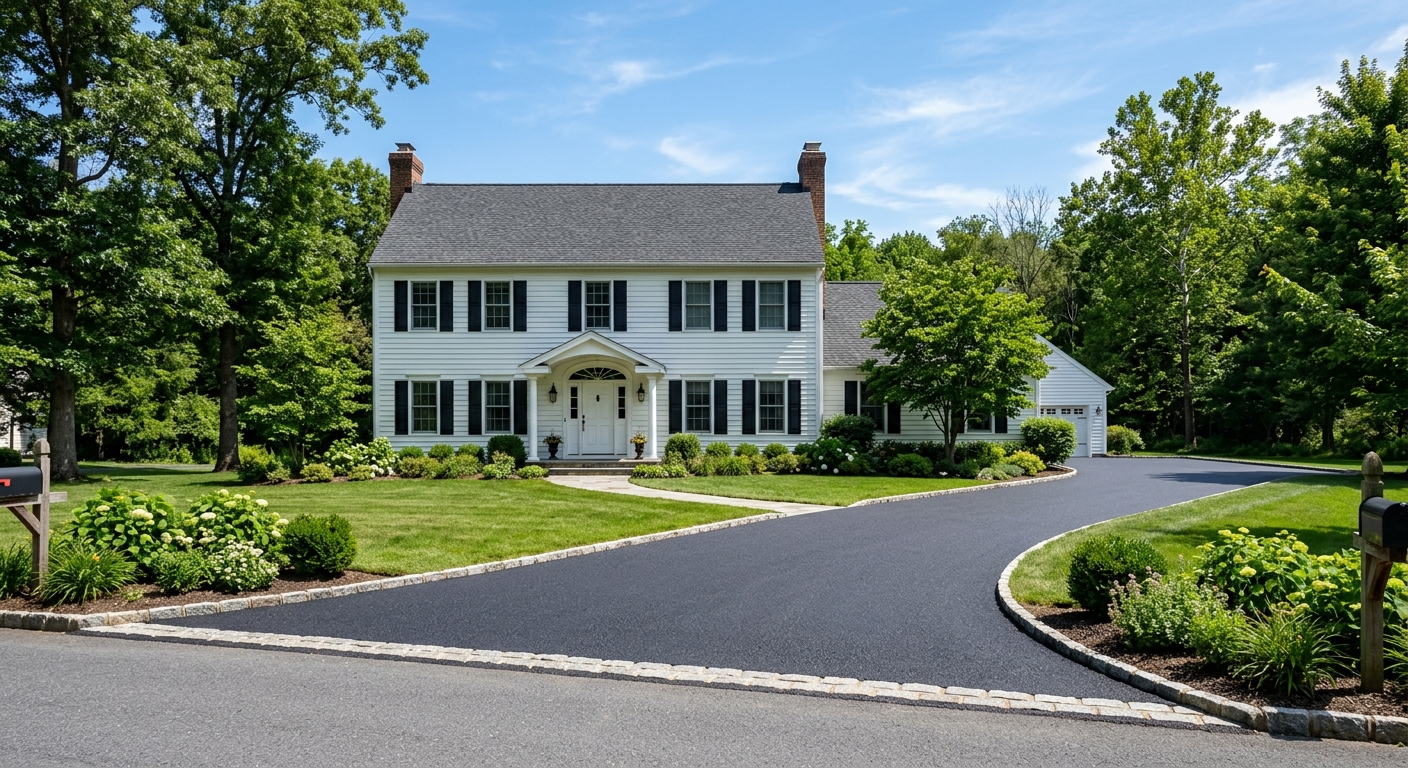
Driveway paving costs in Solebury — 2026
Solebury is a township with a very high share of single-family, owner-occupied homes—86.8% of its housing is single-family, and 90.4% of households own their property (U.S. Census Bureau, ACS 2024). For most Solebury residents, the driveway is a major expense that comes with owning a detached home, and it's not something you'll deal with often. But when you do, how much you pay has less to do with the asphalt or concrete you see on the surface, and more with what’s hidden underneath: the base preparation, drainage, and grading. Our local freeze-thaw cycles and humid summers put steady stress on driveways, especially when water is trapped against Bucks County’s glacial till and silty clay soils, which hold moisture. That’s why local quotes for paving can swing thousands of dollars—and why the cheapest bid rarely survives two hard winters without trouble.
Below are realistic 2026 estimates for common driveway projects in Solebury. Expect to be quoted at the higher end if access is difficult, the stone base must be rebuilt, or your drive is larger than average.
| Service |
Best for |
Lifespan |
Price range |
| Asphalt — full replacement with new base |
failed base, structural cracking |
20–30 yrs |
$4,400–$11,500 |
| Asphalt overlay / resurfacing |
sound base, surface cracking only |
8–15 yrs |
$1,900–$5,700 |
| Sealcoating — single application |
preventive maintenance on sound asphalt |
2–4 yrs |
$250–$900 |
| Concrete — new installation |
long service life, low maintenance |
30–50 yrs |
$6,300–$15,000 |
| Crack filling and patching |
isolated cracks under a quarter inch |
1–3 yrs |
$200–$800 |
| Gravel driveway |
rural, budget, long runs |
5–10 yrs with upkeep |
$900–$3,500 |
Estimates for a typical Solebury driveway. Square footage and base condition drive these figures more than material choice.
Where the water goes
Water is the leading cause of driveway damage in Solebury—and the region’s freeze-thaw cycle makes it unforgiving. A driveway that holds or channels water to the wrong place will not last, no matter what’s on the surface. The minimum slope for effective surface runoff here is at least 2% (about 1/4-inch per foot), which can be achieved by crowning the driveway (higher in the middle) or using a cross-slope. If your driveway slopes toward your garage or house, you’re asking for trouble. Neither the asphalt nor the structure will fare well with repeated water exposure and winter heaving.
In some situations, the land can't be regraded to shed water away. This is where trench drains or channel drains at the low end, especially in front of garages, can intercept runoff. Collected water needs a place to go—ideally “daylighting” to a swale, not dumped into a neighbor’s yard. In Lower Bucks near the Delaware River, silty clay subgrades mean water drains slowly, so pipe outlets or even a dry well may be warranted to prevent base saturation.
Redirecting runoff onto another’s property is a risk regardless of what your building permit says—it’s a neighbor dispute or worse waiting to happen. Every driveway project here must end with water shedding off the hard surface, away from structures, and absorbed safely on your own land.
Asphalt or concrete for a Solebury driveway?
In Solebury, the climate’s freeze-thaw swings and humid summers have a clear say in what driveway material holds up best. Asphalt, being flexible, absorbs ground movement and shrinkage in winter—so even with heavy clay soils or glacial till underneath, it tolerates buckling without splitting. It’s the safer bet in southeastern Pennsylvania, where winter lows of 14°F and regular thaw cycles test any hard surface.
Concrete, on the other hand, is rigid and can last decades longer when everything goes right. But the local problem isn’t cracking—it's salt. Spalling and surface scaling destroy concrete driveways here, driven by repeated de-icing in snowy months. Unless you avoid salt entirely (few actually do), concrete’s service life is often undercut by surface breakdown, even if the slab itself holds together. If you want to go concrete, budget for $6,300–$15,000 and be ready to stay on top of maintenance and cleaning.
Pavers and gravel still have their place. Pavers cost nearly as much as a high-end concrete job, but if installed right on a solid base, individual units can be swapped if one cracks or settles. Gravel is practical on long rural runs, offers excellent drainage (no standing water to freeze), but needs regular raking and top-dressing.
| Option |
Installed cost |
Maintenance |
Freeze-thaw performance |
Lifespan |
| Asphalt — new install |
$4,400–$11,500 |
sealcoat every 3–4 yrs |
excellent, flexes |
20–30 yrs |
| Asphalt — overlay |
$1,900–$5,700 |
same |
good if base is sound |
+8–15 yrs |
| Concrete |
$6,300–$15,000 |
low, avoid de-icing salt |
fair, spalls with salt |
30–50 yrs |
| Pavers |
$10,000–$15,000 |
individual units replaceable |
good, settles gradually |
25–50 yrs |
| Gravel |
$900–$3,500 |
top-dress every 2–3 yrs |
excellent drainage |
indefinite with upkeep |
Choosing a paving company
In Solebury, picking a driveway contractor isn’t just about price. State law requires any contractor signing a contract over $500 to hold Pennsylvania Home Improvement Contractor (HIC) registration. You can and should verify this at hic.attorneygeneral.gov. Also, every employer must have workers’ compensation insurance—verify through the state’s WCAIS system before work begins. In Bucks County, most reliable paving outfits have a real business address, their own equipment, and a track record in the area. Ask which asphalt or stone plant they buy from; reputable companies source aggregate from Delaware Valley quarries and plants, and they can tell you exactly which one. If they can't, you’re likely dealing with a middleman or someone new to the trade. References should be from jobs done at least three years ago—driveways need to endure a few winters before the quality shows.
- Verify HIC registration at the PA Attorney General’s site
- Check workers’ compensation status through WCAIS
- Look for a real business address, not just a mobile number
- Ask about equipment ownership—rented gear is a red flag
- Require upfront written contracts as mandated by the HICPA
- Request references from jobs finished over three years ago
- Ask which aggregate or asphalt plant they buy from
- See proof of insurance—including liability
- Visit a current job site if possible
- Get a full cost breakdown in writing—base prep, thickness, disposal
- Never pay in full until the job is complete
Red flags: high-pressure sales, no verifiable address, refusal to specify materials or base thickness, poor paperwork, or resistance to contract requirements under Pennsylvania law. If any of these show up, walk away.
Driveway permits, approaches and stormwater rules
In most of Bucks County, including Solebury, repaving your existing driveway in the same footprint usually doesn’t require a new building permit. What trips up many homeowners is the approach—where the driveway meets the public road. For state routes in Bucks County, that means getting a Highway Occupancy driveway approach permit from PennDOT District 6, not your local town. Expanding your driveway, adding a parking pad, or changing the connection to the road often triggers not just permit review, but also stormwater evaluation. More impervious surface can mean you’ll need to manage runoff, and you’ll never be allowed to direct water onto your neighbor’s property—the liability sticks with you, permit or not.
For contractor verification, always confirm their HIC registration with the PA Office of Attorney General and check workers’ compensation status in the WCAIS system before any contract is signed. Pennsylvania’s Home Improvement Consumer Protection Act mandates a written contract for any job over $500 and provides a three-day right to cancel, protecting you from aggressive or shady practices.
The honest case for and against sealcoating
Sealcoating helps in Solebury’s climate, but not in the way most marketing suggests. What it does: protects asphalt from oxidation and slows down fading and brittle top-layer wear caused by sun, air, and the occasional fuel or oil spill. It gives a fresh, dark appearance and can buy you some time before the surface needs replacement. What it does not do: add structural strength, fix underlying cracks, or prolong a driveway whose base is already failing. If your driveway has spiderweb cracks, dips, or any base movement, sealcoating is just a band-aid—not a fix.
There’s a catch that's rarely mentioned. Too-frequent sealing leads to crusty layers that can peel and flake. If a contractor urges annual sealing (except on high-traffic commercial lots), they’re selling you more than you need. New asphalt should cure for a full season—at least three to six months—before any sealcoat is applied. Applying it early does more harm than good, locking in solvents and causing premature failure.
Crack filling is more critical here. The freeze-thaw cycles in southeastern Pennsylvania make any water infiltration through open cracks much more destructive than loss of surface luster. A solid crack fill—hot rubberized, not just spray-on—extends your blacktop’s life far more than surface seal. Suspiciously cheap sealcoating (well under $250 for an average Solebury driveway) is usually a watery brush or spray that lasts one season at best.
Widening, extending or adding a parking pad
Projects like widening a drive for more parking, adding a turnaround pad, or extending the surface to reach a detached garage are common upgrades for Solebury homes. These are not just resurfacing —you’re building on new ground. That means a brand new stone base over undisturbed subgrade, which should actually perform better than the original 1960s–1970s sections still in place across some Bucks County tracts. However, every seam between old and new pavement will remain a permanent weak spot—settlement and cracking are nearly guaranteed there over time.
Permitting for these expansions deserves attention. Changing the footprint, size, or location can trigger impervious-surface limits, prompt a stormwater review, and may require setbacks from property lines. And don’t forget—if your new driveway meets a state road, the approach still needs a PennDOT District 6 permit, even if your local township says nothing.
Replacing gravel runs with paved ones follows the same rules—treat it as a new install and make drainage your top priority. Careful planning and solid base prep determine whether the job will last through the tough Bucks County seasons.
Frequently asked questions — driveway paving in Solebury
Do I need an approach permit where my driveway meets the road?
If your driveway connects to a state route in Solebury or anywhere in Bucks County, you’ll need a Highway Occupancy driveway approach permit from PennDOT District 6. This is true whether you’re building a new drive or just expanding the entrance. Townships generally only review zoning or building aspects, so it’s easy to miss the PennDOT step. Not having the right approach permit may stop your project—and could cause headaches if you ever sell the property. For this reason, always confirm which jurisdiction controls your road frontage. For the actual paving, a typical new asphalt install runs $4,400–$11,500, but missing approach permits can add delays and costs that no contractor can undo mid-job.
Are pavers worth the cost in southeastern Pennsylvania?
Pavers are a premium choice for Solebury driveways, and their appeal is real: they can look beautiful, handle occasional settling better than poured surfaces, and make individual repairs possible. Their installation cost is significant—usually $10,000–$15,000 for a standard driveway—comparable to high-end concrete. In Bucks County’s climate, freeze-thaw isn’t the problem; proper base prep is. What often tips the scales is long-term ease of patching and the unique, upscale look. If your budget allows, pavers can be a solid investment. If you skimp on the base or drainage, though, settling gaps and weeds will creep in faster than on asphalt, so hiring a skilled, experienced installer matters even more.
How deep should the aggregate base be here?
Solebury sits mostly on glacial till and silty clay soils—which are less forgiving than sandy soils elsewhere. For a standard passenger-car driveway, most Bucks County contractors would recommend at least 6–8 inches of compacted crushed stone beneath the asphalt or concrete. On softer ground near the Delaware River, 10 inches or more is prudent. This extra depth costs more up front but protects you from frost heaving and sinking patches. Skimping on base thickness is the single fastest way to turn a $4,400 job into a constant repair headache. Always get written confirmation of how much and what type of stone will be used in your estimate.
Does sealcoating fix cracks?
No, sealcoating does not fix cracks. In Solebury’s climate, the real enemy is water—once it gets into cracks, freeze-thaw expands them fast. Sealcoat is a surface protectant; it helps slow down UV damage and petroleum spills, but does nothing to close up an open joint or prevent moisture from getting below. What you want is crack filling, especially hot rubberized material, before any seal is applied. This is more effective maintenance than sealcoating alone and typically costs $200–$800 per application. Just remember: if cracks are over a quarter inch wide or if sections are sinking, you’re due for more than just a surface refresh.
What does an asphalt overlay cost in Solebury?
An asphalt overlay—also called resurfacing—means new blacktop over a stable, existing base. In Solebury this typically costs $1,900–$5,700 for a normal-sized driveway, depending mostly on square footage and the need for edge repair or patching. It generally gives you another 8–15 years of service. Overlays only work if the underlying base is solid; if there’s significant cracking, sinking, or drainage issues, full replacement makes more sense—even if it means paying closer to $7,000 up front.
When is the best time of year to pave in Solebury?
The best season for paving in Solebury and Bucks County is late spring through early fall—May to September. Warm daytime temperatures and consistent overnight lows above 50°F are ideal, allowing asphalt to compact and set correctly. Fall is often too late, as cooling air can lead to improper curing. Scheduling early also beats the autumn rush that pushes prices higher. If you’re going with full replacement at $4,400–$11,500, don’t let anyone rush the process just because “there’s a spot open”; prepping the base and working in proper weather are much more important than date on the calendar.
What kind of soil is under Solebury driveways?
Most Solebury driveways are built over glacial till and silty clay, especially closer to the Delaware River. These soils drain poorly and tend to hold water, which is tough on driveway bases during wet springs and freezing winters. That’s why good drainage and a thick, compacted stone base are critical—and why some driveways built thinner decades ago are now failing. It also means overlays or patching (often $1,900–$5,700) won’t last if the ground movement beneath the base is active. Always make sure a contractor accounts for your specific site before work begins.
Why does my driveway have depressions that hold water?
Depressions—also called “birdbaths”—are usually caused by settling of the base or poor compaction during installation. In Solebury, where heavy clay soils hold moisture, water often collects under the surface and worsens freeze-thaw heaving. If run-off wasn’t addressed during install, water stays put and turns shallow dips into real problems after a few winters. While minor low spots can sometimes be patched as part of an overlay ($1,900–$5,700), severe cases often mean the base was never right to begin with and require full removal and replacement to solve for good.
Why are paving quotes in Solebury so different from each other?
The wide gap in paving quotes around Solebury is almost always explained by what you can’t see—the base preparation, grading, and thickness of both stone and finished asphalt. Some contractors may offer a lower price by skimping on these hidden steps or cutting the thickness below what our freeze-thaw cycles demand. Others factor in proper base depth, disposal of old material, and legitimate PennDOT approach permitting for driveways meeting state roads. You might see prices from $4,400–$11,500 for the same footprint—don’t assume the cheapest job will last. Always compare detailed quotes, not just the final number.