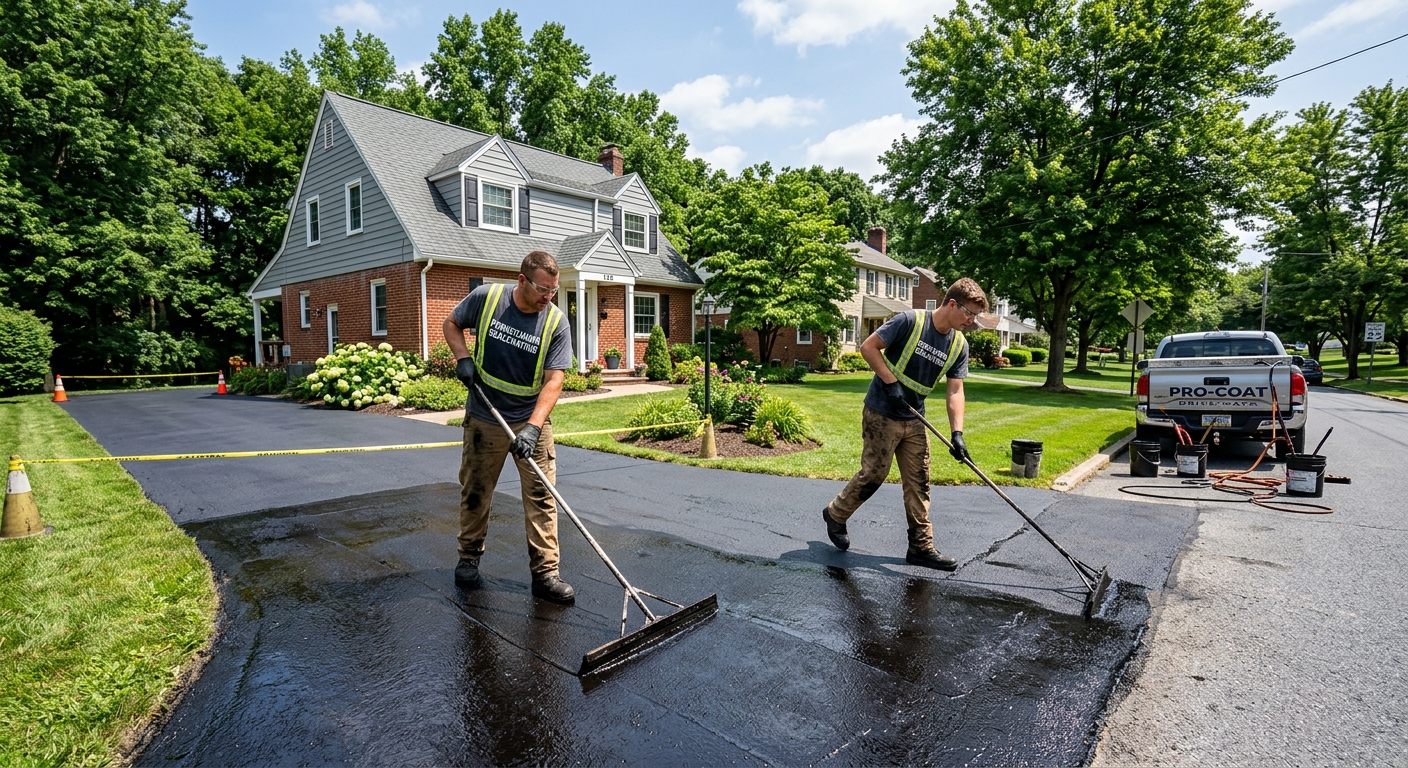
Driveway paving costs in Jackson — 2026
Jackson’s high single-family home share (66.0%) and strong homeownership rate (81.6%) mean that driveway repair or full replacement is a routine, long-term expense for most residents. As homes age—43.9% in this area were built before 1980 (U.S. Census Bureau, ACS 2024)—driveway failures become common, especially after several decades of regular freeze-thaw cycles that are typical of south-central Pennsylvania. Local shale subgrade is another factor: it often requires additional excavation or a thicker base under new asphalt or concrete, which can nudge costs upward compared to areas with more forgiving soils.
For many homeowners, paving estimates can seem all over the map—but most of the price difference is buried where you cannot see it: the sub-base and drainage. Materials are visible and easy to compare, but what determines lifespan (and avoids costly repairs later) are the parts under the surface. A lower price almost always means shortcuts below grade, which do not show until two or three winters have passed. The table below gives typical Jackson price ranges, based on current 2026 estimates and factoring in our region's climate and subgrade challenges.
| Service |
Best for |
Lifespan |
Price range |
| Asphalt — full replacement with new base |
failed base, structural cracking |
20–30 yrs |
$3,600–$9,100 |
| Asphalt overlay / resurfacing |
sound base, surface cracking only |
8–15 yrs |
$1,500–$4,600 |
| Sealcoating — single application |
preventive maintenance on sound asphalt |
2–4 yrs |
$200–$700 |
| Concrete — new installation |
long service life, low maintenance |
30–50 yrs |
$5,100–$12,000 |
| Crack filling and patching |
isolated cracks under a quarter inch |
1–3 yrs |
$200–$800 |
| Gravel driveway |
rural, budget, long runs |
5–10 yrs with upkeep |
$900–$3,500 |
Estimates for a typical Jackson driveway. Square footage and base condition drive these figures more than material choice.
Which surface survives Jackson winters
Given Jackson’s pronounced freeze-thaw cycle and frequent salt usage in winter, the surface you choose for your driveway really matters. Asphalt performs reliably in this climate because it flexes with ground movement. Whenever the ground shifts—especially over our common shale—properly installed asphalt deforms slightly rather than cracking apart. When done right, it lasts 20–30 years, provided the base is solid and crack sealing is maintained.
Concrete, meanwhile, can last up to 50 years, but only if you can live without salt-based deicers. Salt is the enemy: it attacks concrete, causing surface scaling (known as “spalling”) and accelerates failure. Even the highest-quality local mix will not survive Jackson winters if salt is applied repeatedly. Concrete is also a bigger investment up front, but comes with less ongoing maintenance—unless you have to patch salt damage every few years, which becomes frustrating.
Pavers are a premium option where appearance and individual repairs matter; they settle gracefully and, with proper base prep, handle freeze-thaw reasonably well. Gravel is absolutely legitimate for long rural driveways or budgets: it drains well and repairs are straightforward, but it will not boost curb appeal and requires frequent maintenance here.
| Option |
Installed cost |
Maintenance |
Freeze-thaw performance |
Lifespan |
| Asphalt — new install |
$3,600–$9,100 |
sealcoat every 3–4 yrs |
excellent, flexes |
20–30 yrs |
| Asphalt — overlay |
$1,500–$4,600 |
same |
good if base is sound |
+8–15 yrs |
| Concrete |
$5,100–$12,000 |
low, avoid de-icing salt |
fair, spalls with salt |
30–50 yrs |
| Pavers |
$8,100–$12,000 |
individual units replaceable |
good, settles gradually |
25–50 yrs |
| Gravel |
$900–$3,500 |
top-dress every 2–3 yrs |
excellent drainage |
indefinite with upkeep |
What you need before paving in Jackson
In much of York County, including Jackson, you typically do not need a building permit to repave your driveway if you are not expanding it, changing the entrance, or adjusting the footprint. That helps keep maintenance simple for most homeowners, especially those sticking to repair or basic resurfacing jobs.
However, any work at the point where your driveway meets the public road—the approach—will almost always require a permit. For local road entrances, that is handled by the township, not the city. If your driveway connects to a state road (Route 30, Route 74, etc.), a Highway Occupancy Permit comes from PennDOT District 8 instead—a surprise for many, since it is a separate application and inspection.
If you plan to widen your driveway or change its drainage pattern, be ready for stormwater reviews or limits on how much impervious surface you can legally add; you cannot drain runoff onto your neighbor's property, liability or not.
Any paving job over $500 requires a written contract under the Home Improvement Consumer Protection Act (HICPA). It is also your right to verify contractor registration at hic.attorneygeneral.gov, and you should demand proof of workers’ compensation coverage (trackable through WCAIS at wcais.pa.gov). Skipping these steps courts unnecessary risk.
How to vet a paving contractor in Jackson
Jackson’s moderate suburban market draws plenty of legitimate pavers, but it still rewards a careful eye. First check the contractor’s Home Improvement Contractor (HIC) registration at hic.attorneygeneral.gov—no registration, no contract. Confirm workers’ compensation status through WCAIS (wcais.pa.gov), since hiring uninsured crews exposes you financially.
Next, insist on a business with a verifiable Jackson or York County address, not just a mobile number. A company should own most of its equipment—rentals work in a pinch but signal a broker, not a real paving operator. Always ask how long the team has been in the area. Most important: reliable references from jobs at least three years old—because a new driveway often looks perfect for the first summer. Ask their regular asphalt supplier; in this market, a contractor who can’t name a local York County quarry or plant is probably just a broker.
- Verify HIC registration at hic.attorneygeneral.gov
- Check workers’ comp coverage at wcais.pa.gov
- Look for a local business address (not just a cell number)
- Ask if the company owns their paving and grading equipment
- Request references from three or more years ago, not just recent jobs
- Ask for site addresses of past work you can drive past
- Have them name their York County asphalt supplier
- Insist on a written contract over $500 (HICPA rule)
- Request proof of liability insurance
- Look for clear terms about deposits and payment schedule
- Avoid crews who pressure you on the spot or claim the materials are “left over”
- Check that the truck and crew display permanent company signage
Red flags: Out-of-state plates, vague supplier answers, recent formation, no business address, or pushy one-day discounts should end the conversation. Good paving in Jackson starts with someone who knows our soil, climate, and inspection routines because they have worked here for years.
Overlay, patch or full replacement?
The biggest mistake in asphalt repairs is thinking a new layer fixes every problem. In truth, how you should repair depends almost entirely on what’s lurking below—the base. You can get a sense of your underlying problem without a contractor’s help, just by looking closely.
Fine surface cracks under a quarter inch are just normal aging. Cracks stretching in a pattern like alligator skin (alligator cracking), especially across a wide section, mean the base has failed and no “overlay” will last—the whole structure must be replaced. Depressions, especially those that hold water long after rain, signal movement in the subgrade. If just the edges crumble away, you are likely lacking edge support, or water is eroding the side. Potholes are the result of water finding its way down—and by then, damage is already done and patching is only a stopgap.
An honest contractor tests with a probe or core sample before quoting an overlay. If no one checks what is underneath, move on. Overlays only work if the base is solid everywhere, not just in spots. Anything else is burning money for a short-lived improvement.
| What you see |
Likely cause |
Right fix |
Cost |
| Isolated cracks under 1/4 inch |
surface aging |
crack fill and seal |
$200–$700 |
| Alligator cracking over a wide area |
base failure |
full replacement |
$3,600–$9,100 |
| Depressions holding water |
subgrade movement |
excavate and rebuild that area |
$3,600–$5,600 |
| Crumbling edges |
no edge support |
edge repair, consider curbing |
$400–$1,500 |
| Potholes |
water into the base |
full-depth patch, then assess |
$250–$900 |
| Faded but sound surface |
oxidation only |
sealcoat |
$200–$700 |
The honest case for and against sealcoating
Sealcoating is promoted locally as a cure-all for old driveways, but the truth is more measured. What sealcoating really does—when applied properly—is protect the surface asphalt binder from UV damage, water, oil, and fuel spills, slowing the oxidation that turns flexible blacktop into brittle grey. It also restores color, making a tired but sound surface look new again. The typical cost in Jackson is $200–$700 every few years—a decent investment as preventive maintenance.
But a sealcoat is cosmetic and protective—not structural. It will not stop cracks, fix a sinking area, or shore up a failing base. Sealing too frequently is actually bad for the surface, as layers can build up, turn brittle, and flake off irregularly. A brand-new asphalt drive should never be sealed right away; venting of oils and solvents needs a full season or more before any sealer is applied. Overzealous contractors sometimes push annual sealing—this is both unnecessary and can cause more harm than good.
Crack filling is more important than sealing for overall driveway health: it keeps water from working into the base and creating frost heaves or potholes. A proper sealcoat job uses a squeegee or broom to press the sealer in; spray-only applications often leave bald spots and thin layers. A price well below service market—is almost always a quick spray that won’t last even one winter.
Getting thirty years out of a driveway
In Jackson, a driveway's lifespan is rarely determined by the paving material—it's about controlling water and keeping the base dry. Filling cracks every season before water can find its way through is cheap and stops bigger problems before they start. Keep the edges protected and supported: that's where most failures begin, especially with our shale soils. Never let runoff pool at the edge; direct all water away and keep gutters and downspouts pointed elsewhere.
Avoid placing jack stands, trailers, or dumpsters directly on the drive without load spreaders—that kind of point load punches through both asphalt and concrete, especially before the surface matures. New asphalt needs weeks, ideally a few months of warm weather, before you park heavy vehicles or turn steering wheels sharply while stationary.
In winter, salt is a particular concern: on asphalt, the problem isn't the chemical action so much as the repeated melting and refreezing that works water into microscopic cracks. On concrete, salt physically breaks down the surface. Sand, calcium magnesium acetate, or traction grit are safer alternatives, but cost more and require more frequent application. In our climate, managing water and acting early with maintenance beats any material or warranty for long life.
Frequently asked questions — driveway paving in Jackson
Can I pave over my existing driveway?
Overlaying an existing driveway in Jackson is sometimes a real option, especially if your current drive is in decent shape with a sound base and only minor cracks or surface oxidation. The big issue here is what’s going on beneath the surface: if the base is solid, an overlay adds 8–15 years of functional life at a cost of $1,500–$4,600. However, if you’re seeing alligator cracking, depressions, or chronic potholes, simply putting a new layer on top won’t solve the underlying problem—any overlay here will fail quickly after the first few freeze-thaw cycles. A reputable contractor should core sample or probe the drive before quoting an overlay. In short, the visible surface isn’t the whole story: get the base checked, or you risk paying twice.
How often should I sealcoat my driveway in Jackson?
Sealcoating isn’t something you need to do every year in Jackson. With our climate and typical traffic, every 3–4 years is reasonable for most residential drives—enough to protect the asphalt binder from UV and chemical damage, but not so often that you risk buildup and peeling. If your drive is new, wait at least the first full season before the first coat so it can properly cure. A professional sealcoat in the Jackson market runs $200–$700 depending on area and prep work. Always prioritize crack filling ahead of sealing, especially before winter. If someone promises a “deal” for annual spray sealing, that’s a shortcut you can safely decline.
How much does it cost to widen a driveway?
Widening a driveway in Jackson involves more than just adding asphalt or concrete—base prep, grading, and sometimes permits (especially if you’re changing the approach location or increasing impervious coverage) are required. For standard straight runs, widening typically falls at the lower to middle end of the price spectrum for new installs—think $3,600–$9,100 for asphalt and $5,100–$12,000 for concrete, depending on width, length, and subgrade work. If the expansion requires significant excavation, drainage adjustments, or curb rework, costs can climb toward the upper end. Remember, both approach and stormwater rules apply locally, especially if you are changing runoff patterns.
Are door-to-door pavers a problem in Jackson?
Unfortunately, door-to-door paving “crews” still show up in Jackson and elsewhere in York County every spring and summer. They often claim to have “leftover asphalt” from a nearby job and offer to pave at a huge discount for cash. The risk? The work is usually rushed, base prep skipped entirely, and material thickness minimized—so it may look fine for a few months before cracking or eroding. Even small driveways in the area cost $3,600–$9,100 for a proper full replacement, so a deep discount should be a red flag. Always verify registration at hic.attorneygeneral.gov and ask for references—if they refuse, end the conversation.
Can asphalt be laid in cold weather?
In Jackson, optimal asphalt paving occurs from late spring through early fall when daytime temperatures reliably stay above 50°F. Installing asphalt in colder weather risks improper compaction, leading to early cracking and weak bond between layers. Some contractors will push work into the colder months if the weather cooperates, but anything below about 40°F is a gamble. If you’re quoted for a new install or overlay for less than $3,600–$9,100 outside the main season, understand that early failure is a real possibility and most reputable crews will wait for warmer windows.
Is gravel a cheaper option in Jackson?
Gravel remains a cost-effective and practical solution for long, rural, or lightly trafficked driveways in and around Jackson. Installed prices typically range from $900–$3,500 depending on size and grade work. The advantages are low upfront costs and excellent drainage—gravel is especially well-suited to our local soil and freeze-thaw cycles. However, you’ll need to budget time or money every 2–3 years for regrading and top-dressing, especially after winter plowing. For heavily traveled surfaces or high curb appeal, asphalt or concrete may be worth the added investment.
What slope does a driveway need for drainage?
Proper drainage is critical in Jackson’s freeze-thaw climate. The standard for driveways is a slope of at least 1–2% away from structures—meaning a drop of about 1/8 to 1/4 inch per foot. This ensures water flows off the drive and doesn’t pool or run toward the house. Our local shale subgrade and moderate rainfall make it especially important to get this right, since any standing water speeds up pothole formation and freeze damage. When planning new pavement (asphalt or concrete, $3,600–$12,000), always ask your contractor how they will manage surface and edge drainage.
Do I need an approach permit where my driveway meets the road?
Yes, in Jackson, any work to the approach—the section where your driveway meets the public roadway—typically needs a permit. If your drive connects to a state-managed road, PennDOT District 8 handles approach permits; for township-maintained roads, the local township processes applications. Changing the approach or adding a new entrance without the right permit can result in fines or being forced to remove the new work. If your project involves more than just repaving (like widening or shifting the drive), expect to be firmly in permit territory. Costs for this type of work can range within $3,600–$9,100 for asphalt, not including any permit fees.
Why are my driveway edges crumbling?
In Jackson, driveway edge crumbling is often caused by a combination of poor support, water runoff, and our region’s frequent freeze-thaw cycling. If there is no substantial base past the edge, tires rolling off or water moving beneath the asphalt will quickly undermine it—especially when local shale subgrade shifts in spring and fall. Once the edge cracks, rain and meltwater accelerate deterioration. Fixing this typically involves rebuilding the edge with added stone and compacting new material, sometimes with curbing or reinforced edging. In the local market, expect edge repairs to cost $400–$1,500 depending on length and severity. Addressing drainage away from the edge is as important as the repair itself.