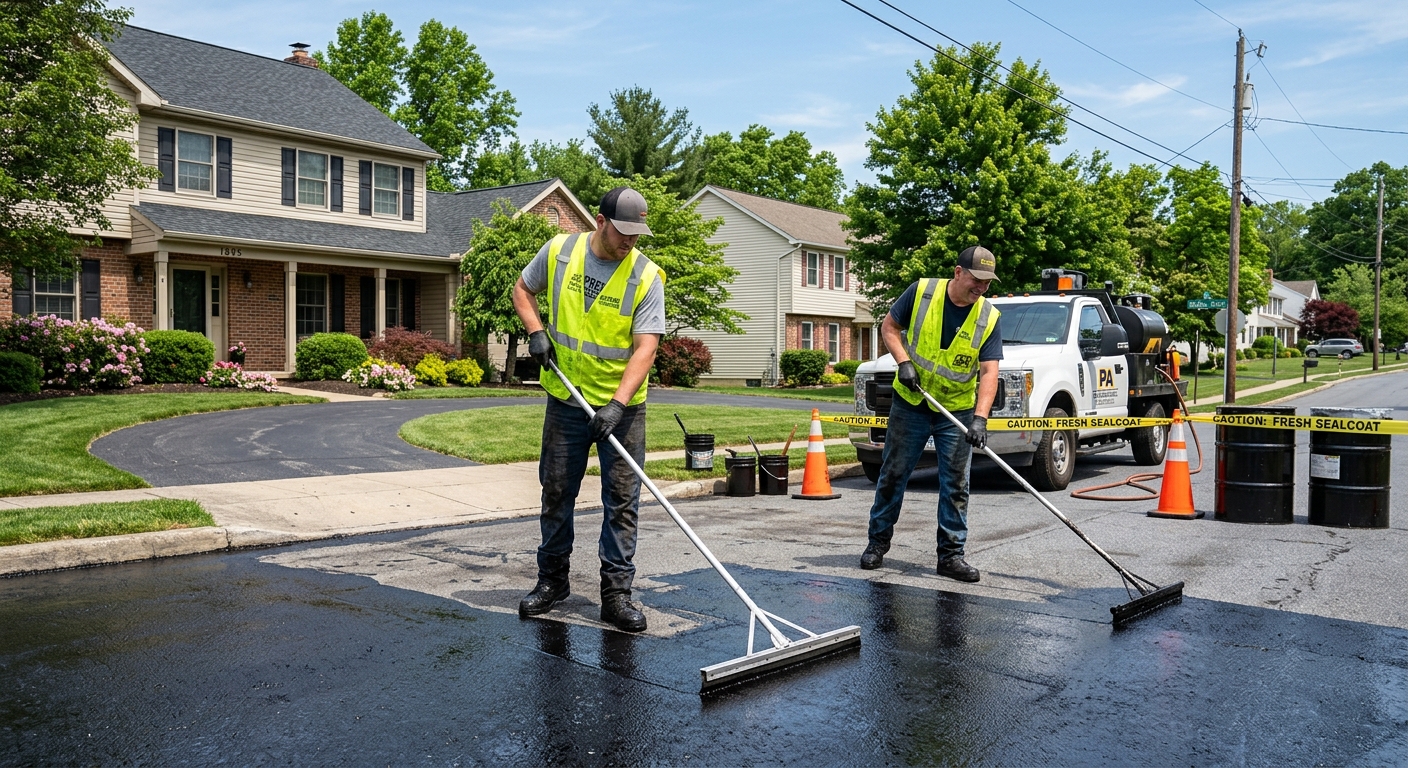
Monessen paving prices by scope — 2026
In Monessen, where 81.5% of housing is single-family and most homeowners (76.8%) take care of their own property, paving is a real investment. A driveway is one of those expenses that comes with owning a detached home—it’s up to you to keep it in shape. The price you pay in Monessen is strongly affected by factors you rarely see: the freeze-thaw cycle in southwestern Pennsylvania is hard on pavement, and much of the ground is shale and clay. Both are unforgiving of shortcuts beneath the surface.
Here’s the point: the real cost difference between two quotes isn’t how thick the asphalt sits on top, or even the material itself. It’s what’s buried underneath—the stone base, the prep, and whether the crew took the time to deal with poor subgrade. Monessen’s climate means you can’t afford to cut corners you’ll never see: winter’s freeze-thaw will find them, and soft ground lets your driveway sag and crack well before its time. That’s why understanding your options—and their lifespan—pays off more than just looking at the sticker price.
| Service |
Best for |
Lifespan |
Price range |
| Asphalt — full replacement with new base |
failed base, structural cracking |
20–30 yrs |
$3,100–$8,100 |
| Asphalt overlay / resurfacing |
sound base, surface cracking only |
8–15 yrs |
$1,350–$4,000 |
| Sealcoating — single application |
preventive maintenance on sound asphalt |
2–4 yrs |
$175–$650 |
| Concrete — new installation |
long service life, low maintenance |
30–50 yrs |
$4,500–$11,000 |
| Crack filling and patching |
isolated cracks under a quarter inch |
1–3 yrs |
$200–$800 |
| Gravel driveway |
rural, budget, long runs |
5–10 yrs with upkeep |
$900–$3,500 |
Estimates for a typical Monessen driveway. Square footage and base condition drive these figures more than material choice.
Why Monessen driveways fail from the bottom up
Most driveways in Monessen don’t fail because the asphalt gets old—they fail from the ground up. Here’s how a driveway should be built in this part of Westmoreland County: first, the clay and shale subgrade is excavated and compacted; then, a stone aggregate base goes in (usually crushed limestone or similar, compacted in layers); finally, asphalt is paved on top.
Every layer matters. The subgrade spreads out the load to the soil below. The aggregate base (the stone under your driveway) takes nearly all the flex—the thicker and better-compacted it is, the less your surface cracks in winter. The asphalt, by itself, can’t hold back the freeze-thaw cycle. When winter hits, water in the subgrade freezes, expands, and lifts the slab unevenly—this is frost heave. Once the ice thaws, the lifted sections sink back (but not perfectly), and cracks appear from the underside up. In Monessen’s climate, with heavy freezing and clay soils, this is more than a possibility: it’s a constant risk.
Low bids cut corners here. Maybe the contractor skips real excavation and just puts new asphalt over whatever’s there—or lays too little, or poor-quality, stone. If the aggregate isn’t laid and compacted in lifts (layers 3–4 inches at a time, compacted with a roller), it can’t support the surface in freeze-thaw cycles. Nobody can see the difference when the trucks drive away, but in three winters, the cracks show up.
You want these figures in writing before you start: at least 6 inches of compacted aggregate base (8–10 if the soil is especially soft), using PA DOT 2A or similar dense-graded stone, compacted in lifts not exceeding 4 inches each. Specify that compaction was done in lifts, not just at the end. Skip this, and you’re paying to pave again long before you should.
What you need before paving in Monessen
If you’re just resurfacing or sealcoating your existing driveway in Monessen—and not changing the footprint—a building permit usually isn’t required. For projects that do alter the layout, curb, sidewalk, or drainage, or if you’re on a state route, different rules kick in. Specifically, the approach where your driveway meets the public road falls under PennDOT District 12, which issues driveway approach permits via the Westmoreland County maintenance office. This catches a lot of homeowners by surprise.
Making your driveway wider or longer means you’re adding impervious surface, which may trigger runoff or drainage requirements. Even if permits aren’t required, Pennsylvania law doesn’t allow you to direct stormwater onto a neighbor’s property; doing so creates liability whether or not the municipality issues a notice.
Whoever you hire, check that their Home Improvement Contractor registration is valid (the Attorney General’s verification site is hic.attorneygeneral.gov), and that any employer on your property carries current workers’ compensation coverage (verify at WCAIS, wcais.pa.gov). For contracts over $500, HICPA requires a written contract—and a three business-day cancellation window. These checks matter more than contractor yard signs or online reviews.
When paving can actually be done in Monessen
Monessen’s climate and supply chain draw a hard line on when paving work can happen: there’s no stretching the window. Hot-mix asphalt can only be placed and compacted while both air and ground are warm enough for proper density; in Southwestern PA’s winters (with a typical design minimum of 8 °F), that means paving usually shuts down from late November through early April. Local asphalt plants in Hempfield Township simply stop producing the mix—you literally can’t buy hot asphalt in January.
Concrete’s no more forgiving. To cure properly, concrete needs above-freezing temperatures. Pouring in winter means slower cure, weak spots, and a rough finish. The same rules generally apply in Greensburg and surrounding Westmoreland County.
You’ll get the best scheduling and sometimes better pricing in the spring and fall—asphalt plant operators and paving crews have more capacity, and you’ll avoid the congested midsummer peak. A crew offering to pave your driveway in December is either using leftover material or taking risks with quality. Stick to the proper paving season, or you’ll pay for it with early cracks and poor surface texture.
Getting thirty years out of a driveway
Long driveway life in Monessen comes down to a few simple actions, ranked by impact. First, crack filling: sealing up fresh cracks before water gets in is the single cheapest way to slow down your driveway’s demise. On a sound base, crack filling and sealcoating ($175–$650) done at the right intervals keeps freeze-thaw from prying the surface open.
Keep your driveway edges supported with stone, curbing, or soil—unsupported edges crumble first in our climate. Slopes and drainage matter: water that moves away from your driveway instead of sitting in “birdbaths” makes a huge difference. Avoid parking heavy vehicles (dumpsters, trailers on jacks) in one spot for long periods. On new asphalt, wait at least 5–7 days before parking and a month before you turn steering wheels while stationary.
For de-icing, use calcium chloride if possible on concrete or sand on asphalt. Salt accelerates concrete spalling in Monessen—especially with our freeze-thaw cycles. On asphalt, frequent salt-melt-refreeze cycles pry the surface apart, and water gets below faster. None of the alternatives are cheap, but they cost less than major repairs years early.
How to tell if the base is gone
If you want to know whether you need a new driveway or just patchwork, you can tell a lot yourself before any contractor sets foot on your property. In Monessen, where old clay and shale subgrades shift with freeze-thaw cycles, the base is usually what’s gone bad, not just the blacktop you see.
Here are the signs: “alligator” cracking—a scale-like pattern over a large area—means the base has failed and a simple overlay ($1,350–$4,000) won’t last a year or two. Isolated, mostly linear cracks with tight edges mean surface aging or minor shrinkage; those can usually be sealed well. Notice any depressions or areas holding water after rain? That’s subgrade movement, where the ground below is sinking or shifting, not just the surface. Crumbling at the edges means the driveway was built with no edge support. If you’ve got potholes, water’s already working through the base.
A contractor who offers to overlay a driveway with major base failure hasn’t done the right inspection. Don’t pay for a quick fix that will last only until the next hard winter.
| What you see |
Likely cause |
Right fix |
Cost |
| Isolated cracks under 1/4 inch |
surface aging |
crack fill and seal |
$175–$650 |
| Alligator cracking over a wide area |
base failure |
full replacement |
$3,100–$8,100 |
| Depressions holding water |
subgrade movement |
excavate and rebuild that area |
$3,100–$4,900 |
| Crumbling edges |
no edge support |
edge repair, consider curbing |
$400–$1,500 |
| Potholes |
water into the base |
full-depth patch, then assess |
$250–$900 |
| Faded but sound surface |
oxidation only |
sealcoat |
$175–$650 |
Beyond replacement: layout changes
If you’re planning to widen your driveway for a second car, extend toward a detached garage, or finally upgrade that gravel track to proper asphalt, your project becomes more than just a straight replacement. Any new footprint means a new base over what might be untouched, soft subgrade—so the preparation matters even more. Keep in mind: the seam where old and new paving meet will always be the weak link, something you may notice as minor settlement or cracks with time.
Monessen homeowners adding square footage to their driveway should consider local stormwater rules: whenever you increase the impervious area, runoff control or even permits may come into play. The approach at the street—for state routes, handled by PennDOT via Westmoreland County—almost always requires a specific permit. You also need to check the required distance from property lines; setback rules can limit just how close you can take your driveway to a neighbor’s yard.
With layout changes, don’t accept a contractor’s “close enough” on depth, base, or drainage. Upfront prep makes the difference between a project that lasts decades and one that settles and cracks before the first winter’s out.
Frequently asked questions — driveway paving in Monessen
Can I cancel a paving contract I signed at my door?
In Pennsylvania, the Home Improvement Consumer Protection Act (HICPA) gives you a three business-day right to cancel any paving contract you signed at your home for work over $500. This applies whether the contractor knocked on your door in Monessen or you invited them yourself. The rule is there to protect homeowners from high-pressure sales tactics. If you feel you made a snap decision on a driveway replacement (which, by the way, can cost anywhere from $3,100–$8,100), you have legal backing to rescind it—in writing—during that window. Make sure you’re communicating in a way you can document (email, certified mail). After those three days, breaking a contract gets more complicated and may mean some loss of deposit.
Is sealcoating a scam?
Sealcoating isn’t a scam in and of itself, but in Monessen it’s over-sold as a cure for problems it cannot fix. Used correctly, sealcoating is preventive maintenance on sound asphalt. It blocks sunlight, slows oxidation, and fills hairline cracks for two to four years. But it won’t repair true cracking or structural problems—if your driveway is alligator-cracked or birdbaths are forming, sealcoating ($175–$650) only hides the symptoms for a season or two. Sadly, some contractors pitch annual sealcoating as necessary, and that’s just a way to keep billing you. The right interval in this climate is every 2–4 years, or when you see the surface going dull and rough. If a contractor recommends sealcoating over major cracks, get a second opinion—or just save your money.
When is the best time of year to pave in Monessen?
In Monessen, the best time to pave is from late April through October. This window matches when local asphalt plants are actually producing material and when ground and air temps ensure proper compaction. Scheduling in spring and fall avoids the summer rush, which can fill up fast in Westmoreland County’s short season. Never let a contractor talk you into paving in the winter, when any hot-mix asphalt must be laid fast and cold ground will ruin the job. For concrete driveways ($4,500–$11,000), it’s the same—temps need to stay above freezing for days so you get a strong cure. Wait for a stretch of dry, mild weather, and you’ll get a driveway that looks good ten years on.
Is an overlay worth it or should I start over?
An asphalt overlay or resurfacing is cost-effective for Monessen driveways only if your existing base is sound and there’s no major alligator cracking or deep depressions. Overlays run $1,350–$4,000 and buy you another 8–15 years, but if you put a new layer over a failed base, it’ll crack again within a couple winters. Do the “buick test”: if you bounce on a spot and feel any give, or if water pools after rain, that base is soft and must be rebuilt from scratch. Don't be afraid to ask a contractor how they’ll check the subgrade. Full replacement makes sense when cracking is widespread or the surface moves underfoot.
Why are paving quotes in Monessen so different from each other?
The biggest reason paving quotes differ in Monessen is what’s being done beneath the visible surface. Some contractors skip excavation, cut the stone base too thin, or don’t compact in layers, especially when bidding low. Others factor in the real costs of working with our tough clay/shale subgrade and proper drainage to keep freeze-thaw from destroying the driveway early. That’s a gap of $3,100–$8,100 for full replacement. Always ask to see exactly what base prep is included—how many inches of stone, what type, and if compaction in lifts is planned. A cheap quote that glosses over the bottom layers will usually cost you much more down the road.
What does compaction in lifts mean?
Compaction in lifts means the contractor lays the aggregate base (the gravel or crushed stone beneath your driveway) in thin layers—typically 3–4 inches at a time—and thoroughly compacts each one before adding the next. In Monessen, where the subgrade is clay and prone to shifting from freeze-thaw, this step is essential. Properly compacted lifts create a strong, stable platform for the asphalt or concrete. Skipping this step or piling all the stone down at once (then running a roller over it) leaves air pockets and soft spots that will settle, rut, or crack. If you’re investing $3,100–$8,100 in a new driveway, it pays to have compaction in lifts written into your contract and confirmed before paving starts.
How much does it cost to widen a driveway?
Widening a Monessen driveway—whether adding another car width, a turnaround, or extra pad space—means excavation, new stone base, and matching the old surface to the new. For asphalt, expect $3,100–$8,100 for a full-width replacement, or less for a partial add-on (if your contractor is only prepping new ground). The seam between old and new can be prone to cracking, especially since clay/shale subgrade may settle differently. Permitting may also apply if you reach a property line or cross a sidewalk or curb—always check with city hall and PennDOT for approach or runoff rules. Plan on a little over the base price since the tie-in isn’t “easy” square footage.
What causes concrete to spall or flake in Monessen?
Concrete spalling—surface flaking or pitting—is a common issue in Monessen, especially with 96.7% of homes built before 1980. It’s usually caused by repeated freeze-thaw pressure and salt exposure. Water gets into surface pores; when it freezes, it expands and pops the surface apart. Salt, used for de-icing, accelerates this by chemically attacking the concrete structure. If your driveway was installed without proper air entrainment or sealed rarely, it’s more at risk. New concrete driveways ($4,500–$11,000) built with the right mix and finished before cold weather arrives last much longer—just avoid salting and reseal as needed. Call out flaking early; minor repair is easier than full replacement.
Does road salt damage driveways in Monessen?
Yes, road salt can damage both concrete and asphalt driveways in Monessen. On concrete, salt causes chemical breakdown that leads to flaking (spalling), pits, and cracks—especially in freeze-thaw winters like ours. On asphalt, salt isn't as aggressive with the binder, but what matters is the repeated melt-freeze-melt cycles. Water from melted snow seeps into cracks, refreezes, and expands, widening the gaps and letting more water get below. Over time, you’ll see surface raveling and even potholes. Using alternatives—like calcium chloride or sand—reduces this risk, but those products aren’t cheap (and neither is patching, at $200–$800). Best approach: only salt where needed, and keep cracks sealed before winter hits.